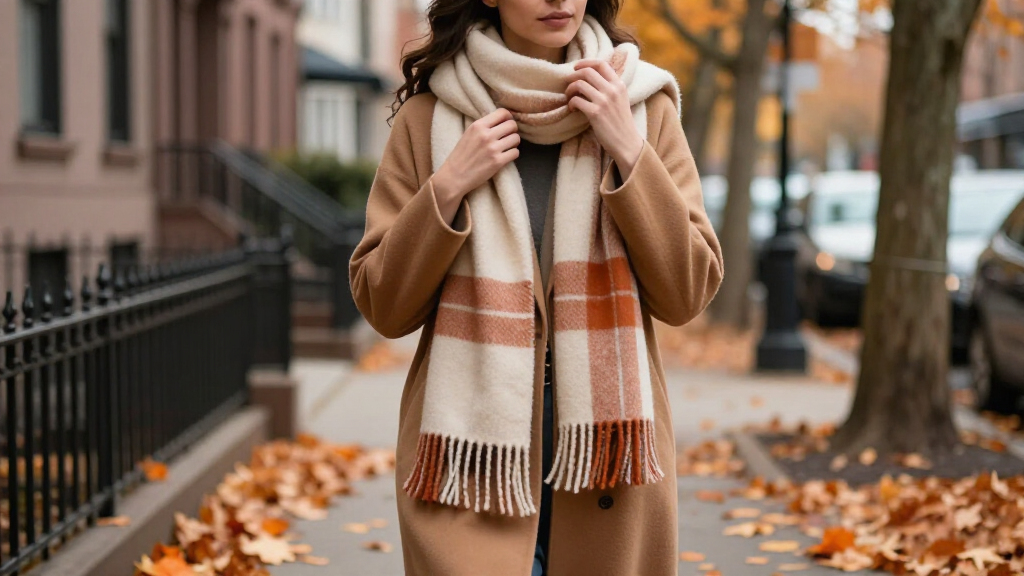

This guide shows you how to style a fall scarf so it looks deliberate rather than thrown on. You will learn how to pick the right scarf for your outfit and coat, then practice six reliable ways to tie and drape it — the Parisian knot, the once-around, the loose drape, the loop, the neckerchief, and the belted wrap. The guide is written for beginners: no styling background is assumed, and every technique takes under two minutes once practiced. All you need is a full-length mirror, one or two scarves you already own, and ten minutes of practice.

Get your wardrobe favorites delivered free with Prime
- Fast, free delivery on millions of items
- Prime Video, Amazon Music and more included
- Member-only deals all year

RIIQIICHY Women’s Fringe Shawl Wrap Pashmina Scarf
- ✔ Brand: RIIQIICHY
- ✔ ASIN: B07FK1FR84
- ✔ Fabric: 70% Polyester, 30% Viscose
CYian Women’s Floral Printed Long Scarf
- ✔ Brand: CYian
- ✔ ASIN: B0HBB2PDPD
- ✔ Size: 70.9 x 35.4 inches (180 x 90 cm)

QIUTIMIY Lightweight Floral Cotton Scarf
- ✔ Brand: QIUTIMIY
- ✔ ASIN: B0DQTW8YLR
- ✔ Material: Polyester cotton
Difficulty: Beginner | Time: 10-15 minutes to practice; 1-2 minutes once learned
What You’ll Need
Tools & Materials:
- A full-length mirror
- At least one scarf: a long rectangular scarf roughly 60-70 inches long and 8-20 inches wide works for most techniques
- A smaller square scarf (20-30 inches) if you want to try the neckerchief style
- The coat or jacket you plan to wear the scarf with
- A belt (optional, for the belted wrap style)
Knowledge:
- None — every technique below is demonstrated with plain step-by-step instructions
Check your scarf’s fabric before starting. Lightweight cotton or silk works for early fall and indoor wear; wool, cashmere, and chunky knits suit colder weather and outerwear. Very thick knit scarves will not work well with the Parisian knot because the folded bulk becomes uncomfortable around the neck — save those for the once-around or loose drape styles. If your scarf is new, remove any tags and give it a quick shake to soften the fabric before practicing.
RIIQIICHY Women’s Fringe Shawl Wrap Pashmina Scarf
Of the three scarves here, this is the one we would reach for when the goal is looking deliberate rather than merely warm. Its 70% polyester and 30% viscose blend gives it a smooth, fluid drape that neither the CYian nor the QIUTIMIY can match — those cotton-heavy weaves sit stiffer on the shoulders, while the RIIQIICHY falls into soft folds that flatter an evening dress or a plain wool coat. At 75 inches long including 3-inch fringes and 27 inches wide, it offers real coverage over shoulders, arms, and back without the bulk of a true blanket scarf.Where it beats both printed options is occasion range. The CYian and QIUTIMIY are unmistakably casual — their patterns read as daytime wear — whereas this wrap moves cleanly from a wedding reception to a dinner out to a flight. That said, it is not perfect. Colors can shift slightly from on-screen images, so buyers with a precise outfit in mind should build in some flexibility, and it shares the lineup’s hand-wash requirement. Compared with the CYian, you give up the cozy oversized-blanket feel; compared with the QIUTIMIY, you give up the bold graphic print. What you get in exchange is polish, and that is why it leads our ranking.
Pros:
- Soft viscose-blend fabric with an elegant, fluid drape
- Generous 75-inch length covers shoulders and arms comfortably
- Lightweight at roughly 8.5 oz, easy to stash in a bag
- Transitions naturally from weddings and evenings to daily wear
Cons:
- Actual colors may differ slightly from product photos
- Hand wash only, with no bleaching
Best for: Buyers who want one scarf that works for dressy occasions, everyday coats, and travel without looking casual
Not ideal for: Anyone seeking a bold printed statement piece or a thick, cozy blanket scarf for deep-winter warmth
Bottom line: The most versatile and refined scarf in this lineup, and the easiest to justify buying first.
“The most versatile and refined scarf in this lineup, and the easiest to justify buying first.”
CYian Women’s Floral Printed Long Scarf
If the RIIQIICHY is the polished choice, the CYian is the practical one — and for many fall wardrobes, practical wins. Measuring 70.9 x 35.4 inches, it is the widest scarf in this comparison, and that extra width is what turns it from a neck accessory into a genuine blanket scarf you can burrow into on a cold commute. The QIUTIMIY runs nearly ten inches narrower, which limits how fully it wraps; the CYian can function as a shawl, a head covering, or an impromptu travel blanket, making it the most utilitarian pick here.The floral print lands somewhere between the QIUTIMIY’s vivid bird-and-bloom graphics and the RIIQIICHY’s solid elegance — decorative but not loud, which helps it pair with coats, sweaters, and dresses alike. Our main hesitation is the conflicting material information: the description cites a cotton-polyester blend while the fabric type lists 100% polyester. Either way it is soft and lightweight, but buyers expecting a natural-cotton hand should temper expectations. It also asks for delicate washing below 30°C with no wringing, a slightly fussier routine than tossing a scarf in with the laundry. Still, for coverage-per-dollar and styling flexibility, it outperforms both rivals.
Pros:
- Largest dimensions in the lineup, usable as scarf, shawl, or blanket
- Lightweight and soft enough for all-season wear
- Versatile pairing with coats, jackets, sweaters, and dresses
- Well-suited as a gift for holidays and birthdays
Cons:
- Conflicting fabric information between blend and 100% polyester
- Requires delicate hand or gentle machine wash below 30°C with no wringing
Best for: Buyers who want maximum size and styling versatility — shawl, blanket scarf, head wrap — without paying a premium
Not ideal for: Dressy evening occasions where a refined drape and fringe matter more than size
Bottom line: The best blend of size, versatility, and value in this roundup — the everyday workhorse of the three.
“The best blend of size, versatility, and value in this roundup — the everyday workhorse of the three.”
QIUTIMIY Lightweight Floral Cotton Scarf
The QIUTIMIY plays a specific role in this lineup: it is the scarf for buyers whose fall style leans bold and graphic. Its vivid bird and floral patterns in rich colors are the most assertive designs of the three — noticeably more eye-catching than the CYian’s softer florals and far more expressive than the RIIQIICHY’s solid drape. If your autumn wardrobe is heavy on neutrals and you want one accessory to carry the outfit, this is the pick that makes that statement.Its styling range is arguably the widest on paper: neck scarf, head scarf, belt, shawl wrap, even a beach cover-up in warmer months. That said, at 70.8 x 31.4 inches it is the narrowest of the three, so it never achieves the cozy blanket-scarf wrap of the CYian, and its cotton-leaning title overstates the fiber content — the actual material is a polyester-cotton blend, so the hand feel sits closer to the CYian than to pure cotton. It is also hand wash only, with no gentle-cycle option like the CYian offers. Compared with the RIIQIICHY, it sacrifices evening polish; compared with the CYian, it sacrifices coverage. In exchange, you get the most personality per square inch in the comparison.
Pros:
- Vivid bird and floral patterns in rich, saturated colors
- Multiple styling options: neck scarf, head scarf, belt, shawl, or cover-up
- Soft, breathable, and lightweight against the skin
- Attractive gift option across many occasions
Cons:
- Polyester-cotton blend despite the cotton-forward title
- Hand wash only, requiring more care than gentle-cycle options
- Narrowest cut of the three, limiting full-coverage wrapping
Best for: Buyers who prioritize bold patterns and creative styling over drape, coverage, or dressy polish
Not ideal for: Buyers wanting maximum wrap coverage or a refined wrap for formal events
Bottom line: The pattern-lover’s pick: the most expressive scarf here, if you accept its narrower cut and stricter care.
“The pattern-lover’s pick: the most expressive scarf here, if you accept its narrower cut and stricter care.”
As an Amazon Associate we earn from qualifying purchases.
Before You Start
Stand in front of your mirror with the coat you will actually wear. The coat’s neckline and weight determine which styles will look right. A fitted wool coat with a collar pairs well with neat knots like the Parisian; a collarless or open coat can carry a looser drape. Also note your scarf’s size: write down or remember whether it is long and narrow, oversized and wide, or small and square, because the steps below specify which scarf shape each technique requires. Practicing with the wrong shape is the most common reason a knot looks bulky or falls apart.
Step-by-Step Instructions
Step 1: Match the scarf to your outfit and coat
Hold your scarf up against the coat or top you plan to wear, then check three things in the mirror. First, judge the weight: pair a chunky knit scarf with a structured coat or a simple sweater, never a thin blouse. Second, judge the color: pick a scarf that either contrasts with your outfit (a rust scarf over a camel coat) or picks up one color already present in it. Third, judge the scale: skip an oversized scarf if you have a petite frame and a fitted coat, and skip a skinny scarf under a puffer. Choose the pairing that balances the scarf’s volume against the outfit’s volume.
Tip: If you own only one scarf, make it a medium-weight wool or wool-blend rectangle in a neutral with subtle pattern — it covers the widest range of the techniques below.
Check: In the mirror, the scarf reads as part of the outfit, not an add-on — no single element looks overwhelmed.
Step 2: Tie the Parisian knot
Fold the scarf in half lengthwise so you have a loop at one end and two loose tails at the other. Drape the folded scarf around the back of your neck so the loop hangs on one side of your chest and the tails hang on the other, both at roughly equal lengths. Pull the two loose tails together through the loop, then tug them until the knot sits comfortably at your throat. Shift the knot slightly to one side rather than dead center — this looks more natural.
Tip: Pull the loop open slightly before feeding the tails through; forcing thick fabric through a tight loop twists the knot. Leave a finger’s width of space at your neck so the knot looks relaxed, not strangled.
Check: The knot holds its shape when you move your head, both tails hang evenly, and the scarf stays put without pinning.
Step 3: Wrap the once-around
Drape the scarf around the back of your neck with one end hanging noticeably longer than the other. Take the long end and wrap it once around your neck from front to back so it crosses behind your neck, then let it fall down your chest beside the shorter end. Straighten both ends so they lie flat against your coat or sweater. Adjust the two ends until they hang at slightly different lengths — perfectly matched ends look stiff.
Tip: This is the best technique for chunky knit scarves that are too bulky to knot. It also sits flat under a coat collar without lumps.
Check: The wrap sits snug but not tight, and the scarf stays in place through normal walking and head movement.
Step 4: Drape the scarf loosely
Take a long or oversized scarf and drape it around the back of your neck with both ends hanging evenly down your front, without any knot or wrap. Tuck both ends inside your open coat or blazer so the scarf frames the lapels, or let them hang outside over a closed coat. Reach up and fluff the section at the back of your neck so it has volume rather than lying flat like a strip.
Tip: This style works best with an open front — unbutton the top button of your coat or wear the scarf over a blazer. It reads polished with minimal effort and is the fastest technique in this guide.
Check: The scarf adds visible volume and frame to the outfit’s front without slipping off either shoulder when you shrug.
Step 5: Create the loop and the neckerchief
Wrap the loop: twist the scarf around your neck twice so both wrapped layers sit close to the collar, then tuck both loose ends inside the wraps or let one tail hang free in front. Fold the neckerchief: take a small square scarf and fold it in half diagonally to form a triangle, roll or fold the triangle into a band about two inches wide, wrap the band around your neck, and knot it once at the front or slightly to the side. Tuck the knot’s ends under the band for a cleaner finish.
Tip: The double loop is warmer than it looks — use it for the coldest days. The neckerchief suits early fall, indoor wear, and tops with open necklines like button-downs and crewnecks rather than coats.
Check: For the loop, no loose fabric bunches under your chin. For the neckerchief, the band lies flat and the knot stays knotted after one adjustment.
Step 6: Belt the wrap
Take an oversized, long scarf and drape it around your neck with one end hanging longer, then bring both ends down the front of your outfit. Fasten a belt over the scarf and your top or coat at your natural waist, catching both scarf ends under the belt. Adjust the fabric above and below the belt so it blouses slightly rather than pulling tight. This creates a defined waistline and works well over long cardigans, trench coats, and sweater dresses.
Tip: Use a belt you can fasten one-handed while holding the scarf in place — a classic buckle belt is easier than a tie belt for this technique.
Check: The belt holds both scarf ends securely, the scarf blouses softly above the belt, and the silhouette shows a defined waist in the mirror.
Common Mistakes to Avoid
- Knotting the scarf too tightly against the throat — After tying any knot, insert two fingers between the scarf and your neck and pull forward slightly. If you cannot, redo the knot one notch looser. Tight knots look uncomfortable and wrinkle the fabric above and below them.
- Pairing a bulky scarf with a slim or delicate outfit — Balance volume on one side of the outfit only. If the scarf is chunky, keep the coat structured and the rest of the silhouette simple. If the outfit is fitted and light, choose a fine-knit or lightweight scarf.
- Choosing a scarf that matches the coat exactly — A scarf the same color as your coat disappears and looks accidental. Pick a shade one or two steps lighter or darker, or a complementary color — rust with camel, olive with cream, grey with burgundy.
- Wearing the same knot with every scarf shape — Match technique to shape: long rectangles for the Parisian knot and once-around, oversized scarves for draping and belting, small squares for the neckerchief. Keep a mental note of which knot works with which scarf in your closet.
Troubleshooting
Problem: The Parisian knot keeps twisting or the tails come out uneven
Solution: Fold the scarf more precisely — align the two short ends exactly before folding in half. If the scarf is very thick or slippery, switch to the once-around, which holds position better on difficult fabrics.
Problem: The scarf slides off the shoulders with the loose drape
Solution: Use a scarf with more texture or weight, since slick silk and polyester slide most. Alternatively, twist the back section once behind your neck before letting the ends fall, which anchors the drape without a visible knot.
Problem: The scarf creates a visible lump under the coat collar
Solution: Switch to the once-around and arrange the wrap low, close to the base of your neck. Or remove the scarf, put the coat on, then add the scarf outside the collar using the loose drape so nothing sits underneath.
Problem: The neckerchief band unravels during the day
Solution: undefined
What Success Looks Like
You have completed this guide when you can tie at least three of the six techniques without looking at the instructions, each in under two minutes. Check yourself in the mirror: the scarf sits where you placed it, nothing digs into your neck, both ends hang at intentional (not accidental) lengths, and the scarf visibly complements the outfit’s color and volume rather than competing with it. A final test: walk across the room, shrug your shoulders, and turn your head. If the scarf holds its shape through all three movements, the styling is secure for the day.
Next Steps
Practice the two or three techniques that suit your wardrobe most for a week until they become automatic — most people default to one everyday knot and one dressier drape. Build scarf variety gradually: one chunky knit rectangle, one lightweight wool in a pattern, and one small square covers nearly every fall outfit. When a scarf pills, shave the surface gently with a fabric shaver or disposable razor on the flattest setting. At the end of the season, fold knit and wool scarves rather than hanging them, which stretches the fabric, and store them with cedar to protect against moths. If a scarf you love keeps failing at every knot style, the issue is usually the fabric — replace it with a medium-weight wool blend, which works with the widest range of techniques in this guide.
Frequently Asked Questions
What scarf length do I need for the Parisian knot?
Aim for at least 60 inches long. Shorter scarves leave tails that barely hang past the knot, which looks unfinished. If your scarf is on the shorter side, the once-around or neckerchief will suit it better.
Can I wear a fall scarf indoors without looking overdressed?
Yes — use the neckerchief or the loose drape over a sweater or button-down, and choose lighter fabrics like cotton or fine wool rather than chunky knits. Reserve heavy wraps and belted styles for outerwear looks.
How do I keep a silk or slippery scarf from sliding out of the knot?
Use a double knot instead of a single one, and keep the knot slightly snug rather than loose. Silk works best with the neckerchief technique; it holds a rolled band far better than a large knot.
Should the scarf match my coat, my top, or neither?
Neither, exactly. Pick a scarf that contrasts with the coat but shares a tone with something else in the outfit — a shoe, a bag, or a layer underneath. This ties the look together without matching any single piece exactly.
Which technique is warmest for very cold days?
The double loop traps the most heat because it wraps two layers close to the neck. The Parisian knot with a thick wool scarf is a close second. The loose drape is the least warm and works best for mild fall days.
Halloween Picks
halloween
As an affiliate, we earn on qualifying purchases.