TL;DR

Get your wardrobe favorites delivered free with Prime
- Fast, free delivery on millions of items
- Prime Video, Amazon Music and more included
- Member-only deals all year
Deep side parts appeared on more than a dozen models at this year’s Victoria’s Secret runway show in Los Angeles, paired with the brand’s signature voluminous blowouts. The look was not universal: Alex Consani and Adriana Lima wore center parts, while performers Megan Thee Stallion and Tate McRae also wore side-swept styles.
Deep side parts and voluminous blowouts featured on more than a dozen models at this year’s Victoria’s Secret runway show in Los Angeles, reviving a hairstyle associated with the brand’s earlier shows and the early 2000s. The styling, led by hairstylist Guido Palau and his team, was prominent but not universal: some models wore center parts.
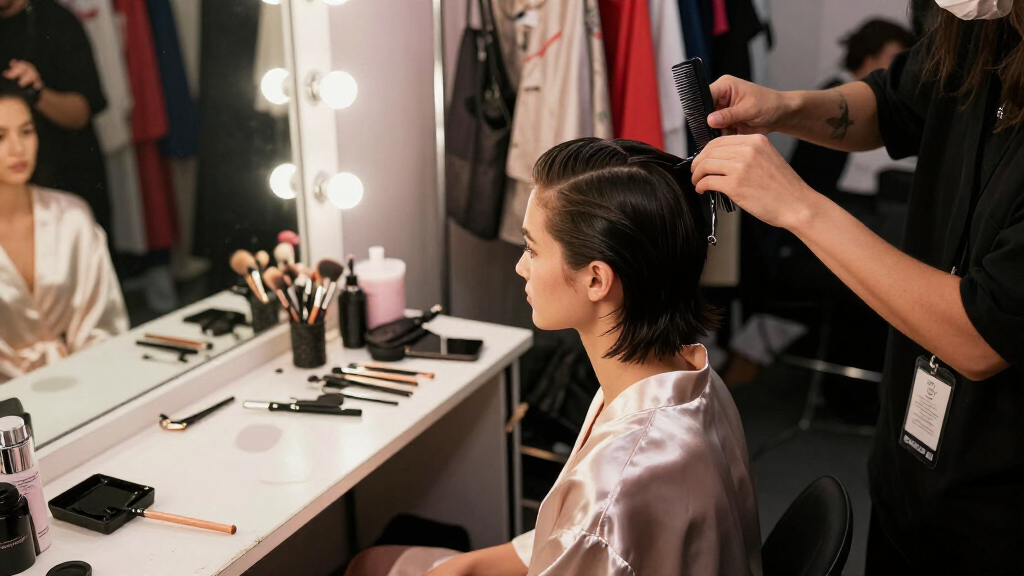
According to Harper’s Bazaar, models including Barbara Palvin and Rosie Huntington-Whiteley spent hours backstage wearing rollers before the show. The technique helped create the bouncy, voluminous waves that accompanied many of the deep side parts. The report describes the look as part of the show’s return to familiar Victoria’s Secret glamour, with original Angels including Adriana Lima and Alessandra Ambrosio also appearing.
The side-swept styling extended to the musical performances. Megan Thee Stallion wore a blowout with bangs arranged over one eye, while Tate McRae wore golden waves flipped to one side as she performed her new single, “Housewife.” These examples put the hairstyle on performers as well as models, though the report does not say that every participant wore the same look.
The runway also showed a mix of parting styles. Harper’s Bazaar reported that Alex Consani and Adriana Lima chose center parts, while Ashley Graham, Caroline Trentini and Paloma Elsesser were among those wearing side parts. The coverage counted more than a dozen models with deep side parts, but did not provide a complete list or an exact total.
A Runway Look Beyond the Part Debate
The show’s beauty choices offer a visible counterpoint to the long-running online debate over side parts versus center parts. The runway did not establish that one style is more fashionable or flattering: it presented both. What stood out was how the side part worked with the loose, touchable blowout, rather than appearing as a standalone trend statement.
For readers following beauty trends, the report gives a current example of an early-2000s style returning in a major fashion show. It also shows that a runway trend does not require a single uniform look. With center parts also present, the show’s styling suggests personal choice and variation, not a definitive ruling on how people should wear their hair.
As an affiliate, we earn on qualifying purchases.
The Blowout Behind the Side Part
Harper’s Bazaar connects the hairstyle to the Victoria’s Secret runway’s earlier beauty image, where bombshell blowouts and glamorous waves were recurring features. This year, Palau and his team used rollers backstage to build volume before the models walked. The report describes the deep side part as a nostalgic detail within that broader styling approach.
The familiar generational shorthand around hair parts also frames the coverage: center parts are often associated with Gen Z, while deep side parts are linked to millennials and the early aughts. That framing reflects the debate described in the report, not a rule about how people of any age wear their hair. There is no single correct part, and individual results depend on personal preference and styling.
As an affiliate, we earn on qualifying purchases.
What the Runway Report Does Not Establish
The source report gives no exact date for the Los Angeles show, no complete list of the models who wore each part, and no precise count beyond saying that more than a dozen models wore deep side parts. It also does not provide statements from Palau, the performers or the models explaining the choices, so the reasons behind individual looks are not confirmed.
The idea that center parts make people look younger is presented as part of the broader beauty debate, not as a finding established by the runway. The show’s mixed styling cannot settle that claim or show whether side parts will remain popular beyond this event.
As an affiliate, we earn on qualifying purchases.
Whether the Side Part Spreads
The immediate development is the runway’s return to side-swept, voluminous styling alongside center-parted looks. The source report does not identify a next show, a planned beauty campaign or a formal trend forecast. Any wider effect on salon requests or everyday styling remains to be seen; the runway appearance alone does not establish how long the look will stay in circulation.
For now, the clearest takeaway is the contrast visible at the show: a substantial group of models wore deep side parts, while others kept their hair centered. Future runway and beauty coverage may show whether the side part continues to appear, but this report captures one event rather than a confirmed industry-wide shift.
As an affiliate, we earn on qualifying purchases.
Key Questions
What hairstyle appeared on more than a dozen models?
Deep side parts, paired with voluminous, wavy blowouts, appeared on more than a dozen models, according to Harper’s Bazaar.
Who led the Victoria’s Secret runway hair styling?
Harper’s Bazaar reports that hairstylist Guido Palau and his team created the runway looks. Models including Barbara Palvin and Rosie Huntington-Whiteley wore rollers backstage for hours before the show.
Did every model wear a side part?
No. The report says Alex Consani and Adriana Lima wore center parts, while more than a dozen models wore deep side parts. It does not provide a complete count of either style.
Which performers wore side-swept hair?
Megan Thee Stallion wore a blowout with bangs styled over one eye. Tate McRae wore golden waves flipped to one side while performing “Housewife.”
Does the runway prove side parts are more fashionable than center parts?
No. The show featured both side and center parts. The report documents the styling at one event; it does not establish that either look is more fashionable or more flattering.
Source: rss
Fall Picks
fall essentials
As an affiliate, we earn on qualifying purchases.