
TL;DR

Get your wardrobe favorites delivered free with Prime
- Fast, free delivery on millions of items
- Prime Video, Amazon Music and more included
- Member-only deals all year
Stylish fall scarves work best when you match their warmth and bulk to the weather and your coat. Wool, cashmere, alpaca, and warm blends suit chilly days; cotton and lighter weaves suit mild weather or indoor wear. Choose a color that connects to your outfit, test how the fabric feels against your neck, and follow its care label.
At 8 a.m., your coat feels right until the wind slips down the neckline. A fall scarf can close that gap, then add a flash of plaid or a soft sweep of color when you step indoors.
This guide helps you choose a scarf by warmth, comfort, size, and color, then wear and care for it without fuss. You’ll find options for chilly walks, mild afternoons, and the days when your scarf needs to work as a wrap, too.
Match scarf weight and fiber to the weather: warm fibers and thicker weaves suit colder days; lighter options suit mild weather or indoor wear.
Choose a shape by trying it with your regular coat; long rectangles offer varied drapes, while infinity scarves are quick to put on.
Use neutrals for easy mixing or let a plaid, stripe, or autumn shade become the outfit’s accent.
Test the fabric at your neck and follow the care label, since softness and washing needs vary by fiber and person.
Try a few real outfit combinations before buying so the scarf fits your existing routine.
Choose a fabric that suits your fall weather
Stylish fall scarves keep you comfortable when you match their fiber and thickness to the temperature and how long you’ll be outside. Wool, cashmere, alpaca, and wool blends are warm choices for brisk days, while cotton and lighter blends can feel easier on mild afternoons or in heated rooms. A thick scarf can feel cozy outdoors but become a hot, bulky extra on the train.
Think about a morning walk followed by an afternoon in the office. A medium-weight wool blend can take the bite out of the wind, then loosen easily when you come inside. The scarf is like a portable patch of shade: useful when you need it, easy to move when the day warms up.
Texture matters, too. A chunky knit gives a casual outfit a soft, substantial look; a fine weave slips more neatly under a coat collar. Check the care label before buying, especially for delicate fibers.
- Cold or windy: Try wool, alpaca, cashmere, or a warm blend.
- Mild or indoors: Look at cotton and lighter weaves.
- Sensitive skin: Feel the fabric against your neck, not just your hand, before you commit.
Pick a scarf shape you’ll actually wear
Stylish fall scarves are easiest to wear when their shape suits your usual coat and the way you like to wrap them. A long rectangle offers room for a simple drape, a loose wrap, or a tucked knot; a square folds into several shapes; an infinity scarf slips on quickly but gives you fewer adjustments. A large blanket scarf can double as a shoulder wrap when you’re indoors or sitting outside.
If you wear a fitted coat with a narrow collar, a fine rectangular scarf may sit comfortably without crowding your neckline. If you often leave the house in a roomy cardigan, a larger wrap can balance the outfit and cover your shoulders while you wait for the bus. There’s no required size or silhouette—comfort and your own preference set the terms.
Try the scarf with the outerwear you wear most. Check whether you can turn your head easily and close your coat without wrestling fabric into place.
- Start with your coat: Note its collar, neckline, and how close it fits.
- Test the length: Wrap the scarf once and see whether the ends fall where you like.
- Check the bulk: Button or zip the coat; if the scarf bunches, try a thinner weave or simpler drape.
Match scarf colors to coats you already own
Stylish fall scarves can quietly tie an outfit together or give it one clear accent, depending on the color you choose. Camel, gray, cream, and navy are versatile starting points because they pair with many coats and sweaters. Checks, plaids, stripes, and autumnal shades can make the scarf the focal point without requiring a new outfit.
For example, a navy scarf can pick up the color in a striped shirt under a gray coat, while a rust check can warm up a cream sweater. Let the scarf borrow a color already in your clothes, or choose one deliberate contrast and keep the rest simple. Color trends vary by region and season, so start with what you enjoy wearing.
Here are a few combinations to try with common coat colors:
| Coat | Easy pairing | When it works |
|---|---|---|
| Camel | Cream, navy, or a muted check | When you want a calm palette with a little texture |
| Black | Gray, deep green, or a brighter accent | When you want either a subtle match or a clear pop of color |
| Gray | Rust, burgundy, cream, or navy | When you want warmth or contrast near the face |
| Navy | Camel, cream, or red-toned plaid | When you want the coat to feel softer or more colorful |
Wear a long scarf without adding too much bulk
Stylish fall scarves look balanced when the wrap matches the scarf’s thickness and your coat’s neckline. For a long scarf, start with a simple drape over your shoulders or one loose wrap around your neck; a tucked-in knot can keep the ends out of the way on a windy walk. Thick fabric usually needs fewer loops, while a fine scarf can handle more wrapping.
Imagine heading to a weekend market in a wool coat with a generous collar. One loose wrap keeps your neck warm, and letting the ends hang gives the scarf room to show its plaid. Under a close-fitting jacket, try a single drape instead; the fabric won’t bunch at the zipper.
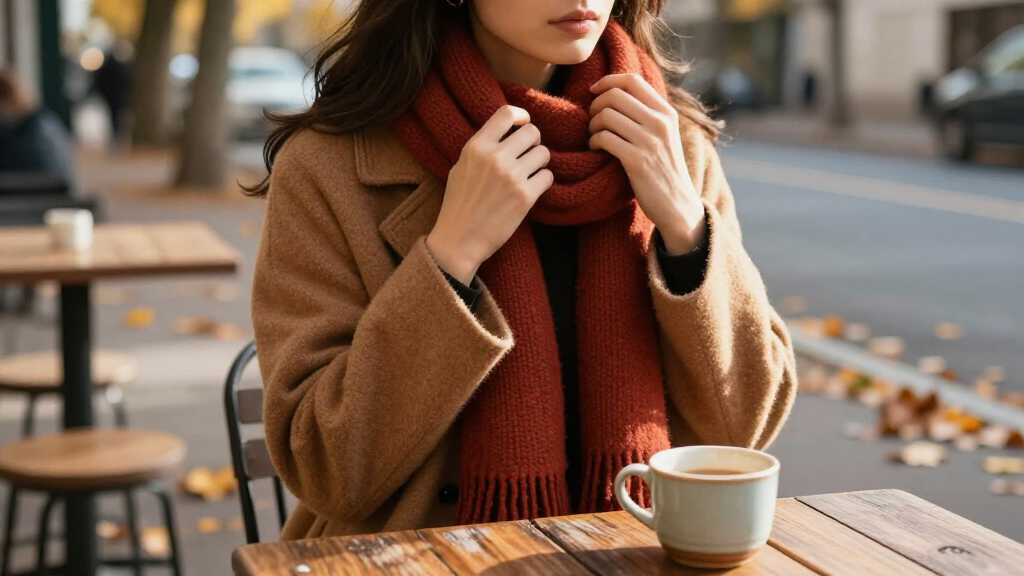
Oversized wraps can also cover your shoulders over a dress or sweater, especially when an outdoor table feels chilly. If you carry a bag, check that the scarf won’t catch on its strap. A comfortable drape should let you move freely and adjust the layers as your day changes.
Let the scarf do one job at a time: use its bulk for warmth or its pattern as an accent, then keep the rest of the layers easy to move in.
Make a scarf feel good from the first wear
Stylish fall scarves deserve a comfort check before you wear them all day: feel the fabric against your neck, notice its weight, and see whether it sheds or wrinkles easily. If wool feels prickly to you, a softer blend or a cotton option may be more comfortable. Fibers feel different from person to person, so a quick touch test can tell you more than a product photo.
For instance, a scarf might feel soft in your hand but scratch when it brushes your jaw. Try it against your skin for a moment, or wear it over a shirt collar if you prefer more coverage. Buying clothes and accessories is personal; a fabric that feels good to one person may not suit another.
Care can shape your choice as much as softness. Wool and cashmere often call for gentler handling than many cotton or synthetic blends, but the specific instructions vary by product. Follow the label, and store a clean scarf folded in a dry place so it’s ready for the next cool morning.
- Check the label: Look for fiber content and washing instructions.
- Test the feel: Try the scarf at your neck, where it will sit.
- Think about your routine: Choose care instructions you can realistically follow.
Get more wear from one scarf all season
Stylish fall scarves work hardest when you choose one that fits several parts of your routine: your commute, your favorite coat, and the weather you actually get. A medium-weight neutral scarf may move easily between a work jacket and a weekend sweater, while a patterned wrap can brighten simpler layers. You don’t need a different scarf for every outfit.
Picture a cream scarf that you drape over a navy coat on a cool morning, then wear as a light shoulder cover with a dress at dinner. Because it adds warmth and a soft contrast, it can travel between those settings without a complicated knot. On warmer days, a lighter scarf can add texture indoors without trapping as much heat.
Before buying, imagine three outfits you’d wear it with. Check that the shade works beside your most-used coat and that the size doesn’t feel cumbersome. If you’re shopping for clothing to wear with the scarf, remember that sizing varies by brand; check each brand’s size guide and fit notes rather than assuming one label means the same fit everywhere.
Frequently Asked Questions
What scarf materials are warmest for fall?
Wool, cashmere, alpaca, and warm wool blends are good options for chilly fall days. Warmth also depends on the weave, thickness, and how you wrap the scarf, so a fine wool scarf may feel different from a chunky knit. Check the care label before buying.
How can I choose a scarf that won’t itch?
Try the fabric against your neck, since that’s where you’ll notice itchiness during the day. If wool feels prickly, look for a softer blend, cashmere, or a cotton scarf suited to your weather. Comfort varies from person to person.
Which scarf colors go with a camel, black, gray, or navy coat?
Camel pairs easily with cream, navy, or muted checks; black works with gray, deep green, or a brighter accent; gray welcomes rust, burgundy, cream, or navy; and navy pairs well with camel, cream, or red-toned plaid. Treat these as starting points and choose shades you like beside your face and clothes.
How do I wear a long scarf without making my coat feel bulky?
Try one loose wrap or a simple drape, especially with a thick scarf or close-fitting coat. Fine scarves can usually handle extra loops, while chunky knits often need fewer. Zip or button your coat and check that you can move your head comfortably.
How should I care for a wool or cashmere scarf?
Follow the scarf’s care label because instructions vary by fiber and product. Wool and cashmere often need gentler handling than many cotton or synthetic blends. Store the scarf clean, folded, and dry between wears.
Conclusion
Choose your next scarf by asking three simple questions: Will it feel comfortable, work with my coat, and suit my weather? If the answer is yes, it can bring warmth and color to everyday layers without demanding a new wardrobe.
On a cool morning, that small strip of soft fabric can turn a familiar walk into a cozier one.
Halloween Picks
halloween
As an affiliate, we earn on qualifying purchases.