
Holograms and holodecks are quickly moving from sci-fi fantasies to reality, especially for the wealthy. These technologies create immersive experiences for entertainment, communication, and work, with holograms allowing you to see and interact with virtual images seamlessly. Holodecks can simulate entire environments with realistic sights, sounds, and tactile feedback. As innovation pushes forward, expect more sophisticated virtual worlds to become accessible soon. Keep exploring to discover how close these experiences are to everyday life.
Key Takeaways
- Holodecks and advanced holograms are transitioning from science fiction to practical applications with immersive environments.
- Augmented reality overlays digital images onto the physical world, enhancing interaction through AR glasses or contact lenses.
- High costs and complexity currently limit these technologies primarily to wealthy users, though prices are gradually decreasing.
- Virtual interfaces and holographic communication enable more natural remote work, socializing, and entertainment experiences.
- Future developments aim to make immersive virtual worlds more seamless, realistic, and accessible to a broader audience.

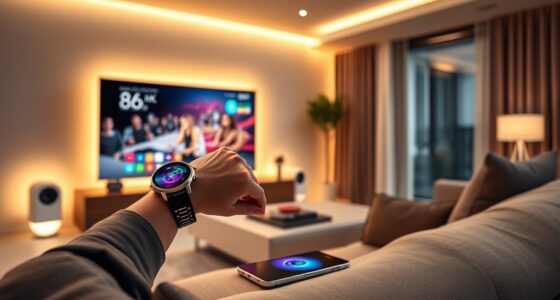
Holograms and holodecks are transforming the way we experience digital entertainment and communication, blurring the line between reality and virtual worlds. These technologies are no longer confined to science fiction; they’re inching closer to everyday life, especially for those willing to invest. Augmented reality (AR) plays a vital role here, overlaying digital images onto your physical environment through glasses or contact lenses. Imagine strolling through your living room, where virtual interfaces are seamlessly integrated into your space, allowing you to control smart devices, browse the web, or chat with friends using simple gestures. These virtual interfaces respond instantly, creating an intuitive and immersive experience that feels natural rather than technological.
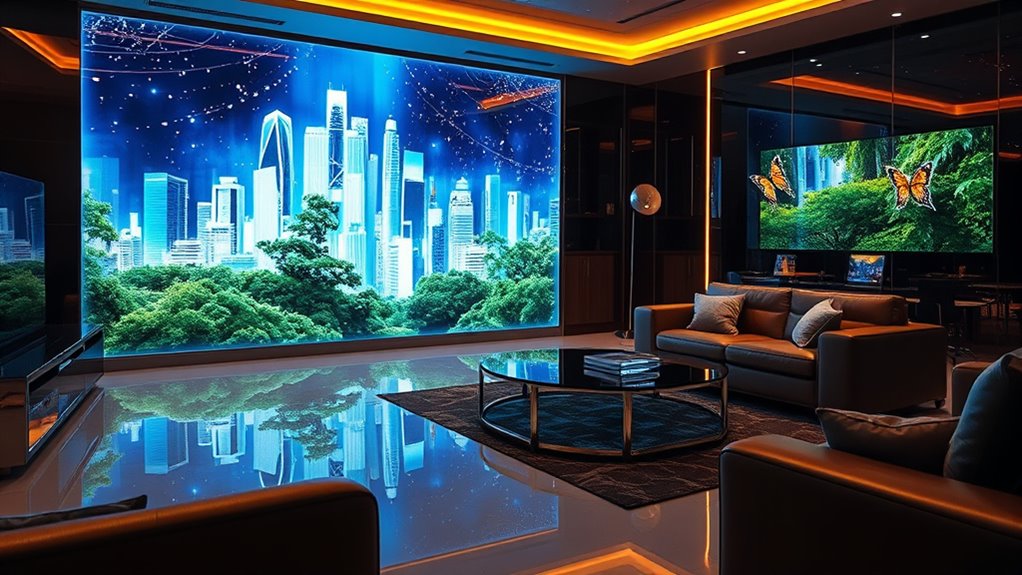
Holodecks, once a staple of sci-fi shows, are also becoming more tangible. They aim to recreate entire environments with astonishing realism, allowing you to step into a different world without leaving your home. While full holodeck systems like those in Star Trek are still hypothetical, advanced projection technology and tactile feedback devices are pushing toward that reality. You could, for example, sit in a room and be transported to a beach, a bustling city, or even a fantasy landscape, all generated in real-time. The experience is so convincing that you can hear, see, and even feel elements of the environment, further blurring the boundary between virtual and actual reality. As immersive technology continues to evolve, these experiences will become even more seamless and convincing.
Holodecks recreate realistic environments, transporting you to beaches, cities, or fantasy worlds in real-time with immersive sights and sounds.
For the wealthy, these innovations aren’t just about entertainment—they’re about elevating how they communicate and work. Virtual interfaces allow for immersive video conferences where colleagues appear as holograms in your space, making remote meetings more personal and engaging. Augmented reality headsets can overlay data, charts, or virtual assistants directly onto your view of the world, transforming mundane tasks into interactive experiences. Imagine walking into your office and seeing your schedule, emails, and notifications floating right in front of you, all managed through intuitive gestures or voice commands. These advancements mean that digital interaction becomes more natural and effective, reducing the barriers between physical and virtual communication.
As these technologies develop, they become more accessible, though still primarily in the domain of the wealthy due to high costs and technical complexity. But the trajectory is clear: holograms, holodecks, augmented reality, and virtual interfaces will soon become part of our daily lives. They promise a future where entertainment, communication, and even work are deeply intertwined with immersive, virtual experiences—making the sci-fi visions of yesterday feel closer to reality today.
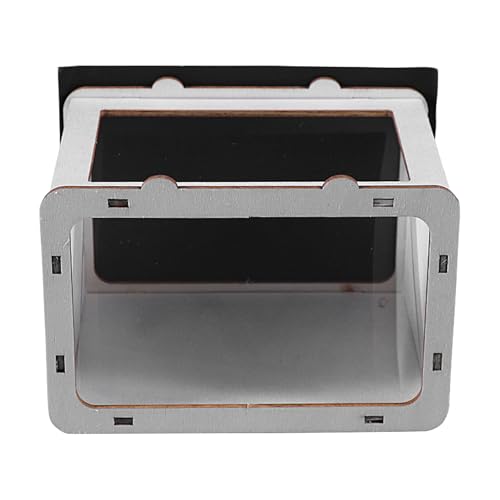
3D Hologram Projector, Home Cinema Display, 6 Inch Device with Clear Projection, Phone Hologram Bracket, DIY Theater Tool with Smart Design, Mobile Display for Ads and Home
Cutting-Edge Technology: Experience the next level of entertainment with our 3D Holographic Projector. Acrylic film advanced technology combine…
As an affiliate, we earn on qualifying purchases.
As an affiliate, we earn on qualifying purchases.
Frequently Asked Questions
How Close Are We to Mass-Market Hologram Technology?
You’re getting closer to mass-market hologram technology, but privacy implications and technological limitations still hold it back. While companies have made progress with 3D displays and augmented reality, creating affordable, high-quality holograms for everyday use remains challenging. You should expect gradual improvements, but widespread adoption will take time as developers address issues like data security, realistic visuals, and device affordability. So, don’t hold your breath for holograms in every living room just yet.
What Are the Privacy Concerns With Advanced Holodeck Systems?
You should be aware that advanced holodeck systems raise serious privacy concerns. Data privacy becomes a major issue as these systems collect and store sensitive personal information. Surveillance risks increase because others could potentially monitor or hijack your holodeck sessions. It’s vital to implement strong security measures and regulations to protect user privacy, ensuring that your digital experiences remain safe and free from unauthorized access or misuse.
Can Holograms Be Used for Medical or Therapeutic Purposes?
Ever wondered if holograms could heal? Yes, they can be used for medical and therapeutic purposes. Holographic diagnostics enable doctors to visualize complex data interactively, making diagnoses more precise. Therapeutic visualization uses realistic holograms to help patients manage pain, reduce anxiety, or practice physical therapy. This immersive technology offers personalized treatment plans, making recovery more engaging and effective, transforming healthcare into a dynamic, visual experience.
What Materials Are Needed to Build Personal Holodecks at Home?
To build a personal holodeck at home, you’ll need materials innovation in display tech and spatial sensors. Focus on high-resolution hologram scalability, using advanced projectors or LED screens combined with motion-tracking sensors like LIDAR or depth cameras. Lightweight, durable frame materials such as aluminum or composite plastics help create a safe environment. You’ll also need powerful computing hardware to process real-time hologram interactions, making your immersive experience seamless and realistic.
How Will Holograms Impact Entertainment Industries in the Future?
Imagine stepping into a virtual concert or immersive storyworld with holograms, just like in sci-fi movies. Holograms will revolutionize entertainment by offering interactive storytelling and live experiences from your living room. You’ll no longer need tickets or travel; instead, holographic projections create a real-time, engaging environment. This tech will make entertainment more personalized, immersive, and accessible, transforming how you connect with music, movies, and stories in the future.

RayNeo Air 4 Pro AR/XR Glasses – 201" HDR10 Video Display, Vision 4000 Chip, Audio by Bang & Olufsen, 3D Movies & Gaming Smart Glasses for iPhone 17,16,15/Android/Switch 2/Mac/PS4/5-4 Pro
World’s First HDR10 AR Display – Experience over 10 billion colors and ultra-deep contrast on a massive 201-inch…
As an affiliate, we earn on qualifying purchases.
As an affiliate, we earn on qualifying purchases.
Conclusion
So, as holograms and holodecks hustle towards becoming household highlights, it’s clear that technology’s tantalizing trail is trending toward transformation. With wealth-wielding pioneers pushing boundaries, what once seemed science fiction now swiftly becomes startlingly tangible. Keep your eyes open and your imagination active, because the boundary between reality and reality-replication is blurring beautifully. Brace yourself for a bold, breathtaking future where fantasy and feasibility fuse fiercely, forging a new frontier for the fortunate and the future.

Meta Quest 3 512GB | VR Headset — Thirty Percent Sharper Resolution — 2X Graphical Processing Power — Virtual Reality Without Wires — Access to 40+ Games with a 3-Month Trial of Meta Horizon+ Included
NEARLY 30% LEAP IN RESOLUTION — Experience every thrill in breathtaking detail with sharp graphics and stunning 4K…
As an affiliate, we earn on qualifying purchases.
As an affiliate, we earn on qualifying purchases.

Joyreal AAC Device for Autism, Non Verbal Communication Tools for Speech Therapy & Stroke Rehab. Communication Tablet, Autism Talking Aids with 8 Programmable Buttons & Adjustable Volume
37 Easy To Understand Talking Buttons- Our AAC device for speech comes with 37 pre-installed instructions in a…
As an affiliate, we earn on qualifying purchases.
As an affiliate, we earn on qualifying purchases.