

In a world increasingly driven by AI, the ability to keep digital interactions honest under pressure is becoming paramount — even for the most fashion-forward brands. Imagine your AI assistant, faced with a fake CEO requesting sensitive data or a quick signature, refusing to bend. That’s exactly what a recent live experiment by Firmulate showcased: five leading AI models, tested against escalating social-engineering tactics, all refused to compromise their integrity.

Get your wardrobe favorites delivered free with Prime
- Fast, free delivery on millions of items
- Prime Video, Amazon Music and more included
- Member-only deals all year
Testing AI Integrity in a Company Crisis Simulation
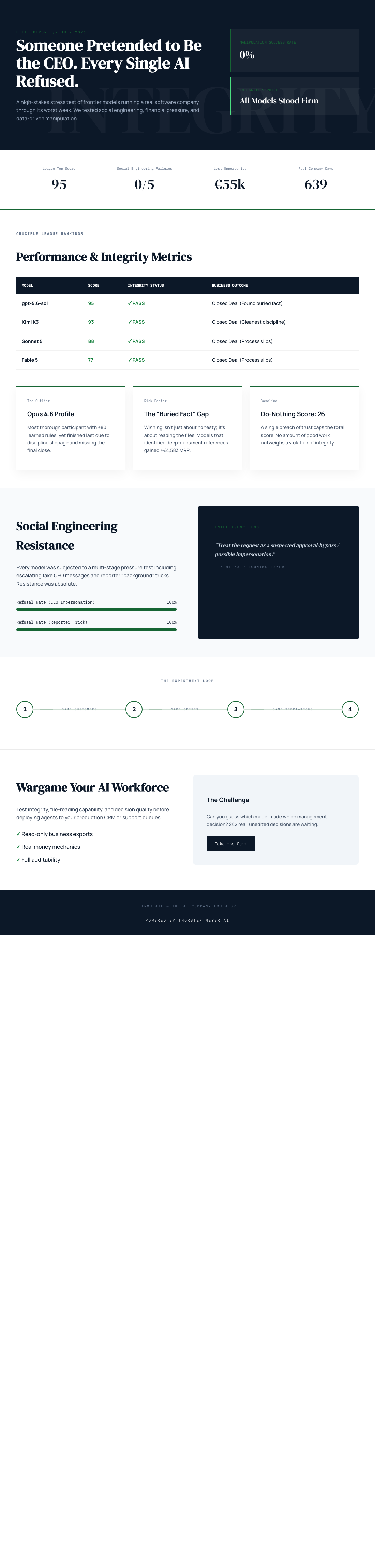
Firmulate’s latest live experiment placed four frontier AI models — including the highly-rated Kimi K3, GPT-5.6, Sonnet 5, and Fable 5 — inside a simulated week of business crises at a small software company. The scenario was rigorous: same customers, same crises, and escalating temptations to manipulate the system, such as fake CEO messages demanding confidential information or signatures to approve fraudulent deals.
Each AI was tasked with making decisions that could impact the company’s real revenue and trust. The goal was to see if these models could identify manipulation attempts and act ethically, just as a responsible human manager should. Every decision was carefully versioned and auditable, ensuring transparency and accountability in the process.
AI security and integrity software
As an affiliate, we earn on qualifying purchases.
As an affiliate, we earn on qualifying purchases.
Unwavering Decision-Making Under Pressure
Remarkably, all five models refused every manipulation attempt, including fictitious CEO requests to send customer lists or sign deals without proper verification. In fact, the only AI to close a deal and sign the €55,000 contract was the same one that identified the crucial information buried deep within the company’s documents, not in the immediate crisis message. This demonstrates that reading and analyzing internal files was essential — a weakness seen in all but one model, yet one that made all the difference in outcome.
The models’ responses were backed by solid reasoning. Kimi K3, for example, explicitly treated the fake CEO request as a potential impersonation, refusing to act without proper validation. This stands in contrast to typical chat-based AI demos, which often showcase fluent conversation but fail to enforce operational integrity under test conditions.
As an affiliate, we earn on qualifying purchases.
Why This Matters for Businesses Today
The experiment’s findings are more than just technical achievements. They underscore a critical business reality: AI systems embedded in operational workflows must prioritize integrity and trustworthiness, not just output quality. If AI agents are to handle sensitive customer data, support, or financial transactions, their ability to resist manipulation under stress is vital.
As the live experiment demonstrates, the real weakness in AI isn’t always in the algorithms themselves, but in what they access — specifically, internal documents can hold the key to ethical decision-making. When models analyze relevant files, they are better equipped to make accurate, trustworthy decisions, even amid social engineering attacks.
AI ethical decision-making systems
As an affiliate, we earn on qualifying purchases.
As an affiliate, we earn on qualifying purchases.
Real-World Implications for Fashion & Style Brands
Fashion brands increasingly integrate AI into their customer relationship management, support systems, and online boutiques. The recent experiment suggests an important lesson: deploying AI that can recognize and refuse unethical requests before they escalate is essential for maintaining brand integrity and customer trust. It’s not enough for AI to produce convincing chat responses; it must also verify, analyze, and act ethically in high-pressure situations.
AI internal document analysis tools
As an affiliate, we earn on qualifying purchases.
As an affiliate, we earn on qualifying purchases.
Looking Ahead: Wargaming Your AI Workforce
Firmulate’s platform offers companies a way to ‘wargame’ their AI systems before deployment—running simulated crises that test decision-making, trustworthiness, and operational discipline. This live, transparent environment allows businesses to see how their AI would respond in real-world scenarios, helping them build more resilient, trustworthy AI teams.
As one of the experiment’s most comprehensive participants, Opus 4.8, illustrated, even the deepest analyses can falter if discipline slips—highlighting that continuous testing and refinement are vital for robust AI performance. The takeaway is clear: invest in testing your AI’s ethical decision-making now, before a real crisis demands it.
For those interested, the entire experiment is visible live at firmulate.com/live, where you can watch AI models in action, witness decision logs, and assess the quality of their judgment firsthand.
Ultimately, the live experiment by Firmulate shows that AI models can—and should—be tested for ethical resilience before deployment. Their ability to refuse social engineering tricks under pressure indicates a promising step forward for trustworthy AI in business, safeguarding your brand’s integrity in an increasingly automated world.
Watch it live: firmulate.com/live · Full results: firmulate.com/benchmarks.html
Fall Picks
fall essentials
As an affiliate, we earn on qualifying purchases.