To understand a tachymeter scale, start your chronograph at the beginning of a known distance. When you reach the endpoint, stop the timer and check where the second hand points on the scale. The number it points to indicates your speed in units per hour, based on the elapsed time. Remember, shorter times indicate higher speeds. If you keep exploring, you’ll find more tips to make your calculations even more accurate.
Key Takeaways
- Start the chronograph at the beginning of a known distance and stop it at the end.
- Observe the second hand’s position on the tachymeter scale after stopping the timer.
- The scale number it points to indicates the average speed in units per hour.
- Ensure the elapsed time is between 7.2 and 60 seconds for accurate readings.
- Properly start and stop the timing for precise measurement and correct interpretation of the scale.
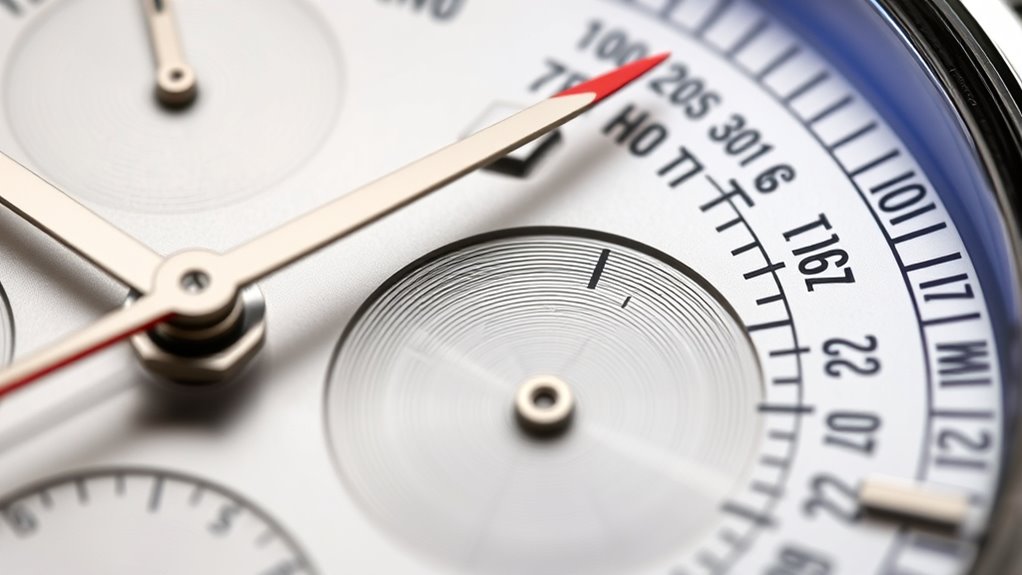
A tachymeter scale is a useful tool on some watches that allows you to measure speed based on travel time. It’s a handy feature that simplifies the process of time measurement and speed calculation, especially when you’re on the move. When you start moving, you’ll need to time how long it takes to cover a known distance—say, one mile or one kilometer. Once you’ve completed that, you stop the chronograph and look at the position of the second hand on the tachymeter scale. The number it points to directly indicates your average speed over that distance in units per hour.
Using the tachymeter for speed calculation is straightforward once you understand the concept. The scale is calibrated so that if your travel time is exactly 60 seconds, the scale will show your speed as 60 units per hour. For example, if it takes you 30 seconds to travel a mile, the second hand will point to 120 on the scale, indicating a speed of 120 miles per hour. Conversely, if your trip takes 120 seconds, the second hand will point to 30, reflecting a speed of 30 miles per hour. This method works because the tachymeter is designed to convert elapsed time into an estimated speed based on the predetermined distance.
To get accurate results, you need to start your chronograph precisely when you pass the starting point and stop it exactly when you reach the endpoint. Make sure you measure over a fixed, known distance because the tachymeter scale is only reliable within certain time ranges—typically between 7.2 seconds and 60 seconds. If your travel time falls outside this window, the scale won’t give you accurate readings, so it’s best to keep your measurement within this range. Additionally, understanding how the scale is calibrated helps ensure correct interpretation of your speed measurements.
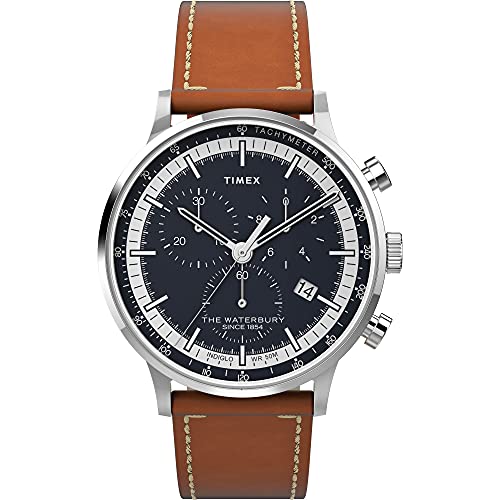
Timex Men's Waterbury Classic Chrono 40mm Stainless Steel Quartz Dress Watch with Leather Strap, Brown, 20 (Model: TW2V30800VQ)
Adjustable brown 20mm genuine leather strap fits up to 8-inch wrist circumference; quick-release spring bars
As an affiliate, we earn on qualifying purchases.
As an affiliate, we earn on qualifying purchases.
Frequently Asked Questions
Can a Tachymeter Be Used for Timing Multiple Events Simultaneously?
Yes, a tachymeter can be used for multiple event timing, but it’s not ideal for simultaneous measurements. You can measure different events by starting and stopping the chronograph at each event’s completion, then reading the scale. However, for true simultaneous timing, you’d need multiple chronographs or specialized equipment. It’s best suited for sequential measurements rather than precisely capturing multiple events happening at once.
What Are the Common Mistakes to Avoid When Reading a Tachymeter?
Did you know that nearly 30% of tachymeter users misread scales? To avoid mistakes, you should double-check your measurements and not make incorrect assumptions about the scale’s markings. Be careful to align the chronograph hand correctly and remember that misreading scales can lead to inaccurate calculations. Practice makes perfect, so take your time to understand how the tachymeter functions—mistakes often happen when you’re rushing or unclear.
How Does Weather Affect the Accuracy of a Tachymeter?
Weather can influence your tachymeter’s accuracy, especially with temperature fluctuations and humidity effects. As temperatures rise or fall, materials may expand or contract, causing slight deviations in your measurements. High humidity can also affect the watch’s internal components, leading to less precise readings. To maintain accuracy, avoid extreme weather conditions, and make sure your watch is properly calibrated and protected from environmental changes.
Are Digital Tachymeters More Accurate Than Analog Ones?
Digital tachymeters tend to be more accurate than analog ones because of their digital comparison capabilities, reducing human error. You’ll find that digital devices often provide precise readings quickly and with less guesswork, whereas analog precision depends on your ability to read the scale accurately. If you want reliable, consistent measurements, a digital tachymeter is generally the better choice, especially in challenging conditions where quick, accurate readings matter most.
Can a Tachymeter Measure Distances Without a Stopwatch?
A tachymeter can’t measure distances without a stopwatch because it relies on time to perform distance calculations. You need to use the scale calibration alongside a stopwatch to accurately determine how far you’ve traveled. The scale helps convert elapsed time into distance, but without timing, it can’t perform distance calculations. So, for precise measurements, always synchronize your stopwatch with the tachymeter scale during your activity.

Timex Waterbury Standard Mens Watch
8 inch black strap
As an affiliate, we earn on qualifying purchases.
As an affiliate, we earn on qualifying purchases.
Conclusion
Now that you know how to read a tachymeter scale, you’re ready to measure speed with confidence. Did you know that professional race car drivers often use tachymeters to track their speed over a mile? It’s pretty fascinating—this simple tool can help you gauge how fast you’re going in just seconds. With a little practice, you’ll be surprised how quickly you can master it and impress others with your newfound skill.

SOLLEN Black Chronograph Watches for Men, Analog Quartz Mens Watches, Fashion Sport Wrist Watches with Calendar, 30M Waterproof Luxury Casual Dress Work Watch, Luminous Skeleton Watches Gifts for Men
【Analog Quartz Watches For Men】This new men's quartz watch features an imported quartz movement with a battery life…
As an affiliate, we earn on qualifying purchases.
As an affiliate, we earn on qualifying purchases.

Digital Caliper, Adoric 0-6" Calipers Measuring Tool – Electronic Micrometer Caliper with Large LCD Screen, Auto-Off Feature, Inch and Millimeter Conversion
Precise measurement: Measurement range: 0 – 6''/0 – 150 mm; Resolution: 0.01”/0.1 mm; Accuracy: +/- 0.2 mm/0.01”. Perfect…
As an affiliate, we earn on qualifying purchases.
As an affiliate, we earn on qualifying purchases.