
The best high-end turntables balance playback quality with the setup, features, and upkeep you actually want. I’d put the Technics SL-100C first for its direct-drive design and focused, upgrade-friendly approach; the Denon DP-3000NE stands out for a more fully featured premium setup, while the Dual CS 529 adds convenient automatic operation. The main tradeoffs are manual control versus automation, built-in conveniences versus system flexibility, and straightforward setup versus room to tailor the sound. I’ve included options for different budgets and listening habits, including a DJ-style deck and models with Bluetooth or USB. Read on for the full breakdown and a guide to choosing the right turntable for your system.

Get your wardrobe favorites delivered free with Prime
- Fast, free delivery on millions of items
- Prime Video, Amazon Music and more included
- Member-only deals all year
Key Takeaways
- The Technics SL-100C is the strongest all-rounder in this lineup for listeners who prioritize a direct-drive platform and a focused, upgrade-friendly design over automation.
- The Denon DP-3000NE is the premium-feature choice, while its added sophistication makes most sense for buyers building a higher-end system around it.
- Automatic operation is a real usability advantage, not a sound-quality category. The Dual CS 529 models suit hands-off listening, while the Technics SL-100C and Pro-Ject XA B call for more manual involvement.
- Connectivity changes the use case. The Audio-Technica AT-LP120XUSB supports USB-based archiving, and the Technics SL-40CBT adds Bluetooth; neither feature alone makes a turntable a better fit for a traditional analog system.
- Several products are specialized rather than direct substitutes. The Pioneer DJ PLX-1000 is aimed at DJ-style use, while the Fluance RT81 and Audio-Technica AT-LP120XUSB offer accessible entry points compared with the more premium-focused decks.
| Fluance RT81 Elite Belt-Drive Turntable with AT95E Cartridge and Built-In Preamp, Walnut |  | Best Entry Point for a Traditional Hi-Fi Setup | Drive type: Belt drive | Cartridge: Audio-Technica AT95E | Stylus: Diamond elliptical | VIEW LATEST PRICE | See Our Full Breakdown |
| Dual CS 529 Fully Automatic Turntable, Black |  | Best for Hands-Off Listening | Drive type: Belt drive | Operation: Fully automatic or manual | Connectivity: Bluetooth | VIEW LATEST PRICE | See Our Full Breakdown |
| Technics SL-100C Premium Class Direct Drive Turntable, Black |  | Best for Stable, Low-Fuss Playback | Drive type: Coreless direct drive | Motor: Brushless DC | Cartridge: Audio-Technica AT-VM95C, pre-installed | VIEW LATEST PRICE | See Our Full Breakdown |
| Audio-Technica AT-LP120XUSB-BK Direct-Drive Turntable with USB, Black |  | Best for Vinyl Digitizing and Format Flexibility | Drive type: Direct-drive DC servo motor | Speeds: 33⅓, 45, and 78 rpm | Operation: Fully manual | VIEW LATEST PRICE | See Our Full Breakdown |
| Pioneer DJ PLX-1000 Professional Direct-Drive Turntable |  | Best for DJ and Turntablist Use | Drive type: Direct drive | Startup time: 0.3 seconds | Pitch control: ±8%, ±16%, and ±50% | VIEW LATEST PRICE | See Our Full Breakdown |
| Audio-Technica AT-LP8X Semi-Automatic Direct-Drive Turntable |  | Best for Flexible Playback | Drive: Direct drive | Operation: Semi-automatic | Playback speeds: 33-1/3, 45, and 78 RPM | VIEW LATEST PRICE | See Our Full Breakdown |
| Technics SL-40CBT Direct Drive Turntable with Bluetooth |  | Best for Wireless Listening | Drive type: Coreless direct drive | Connectivity: Bluetooth | Cartridge: Audio-Technica AT-VM95C | VIEW LATEST PRICE | See Our Full Breakdown |
| Dual CS 529 Fully Automatic Turntable, Walnut |  | Best for Hands-Off Operation | Operation: Fully automatic; manual operation also available | Connectivity: Bluetooth audio transmission and remote control | Tonearm: Twin gimbal bearing with pivot ball bearings | VIEW LATEST PRICE | See Our Full Breakdown |
| Denon DP-3000NE Direct-Drive Turntable with Automatic Start/Stop |  | Best for Cartridge Flexibility | Drive type: Direct drive | Platter: Die-cast aluminum | Tonearm: S-shaped | VIEW LATEST PRICE | See Our Full Breakdown |
| Pro-Ject XA B Acrylic Turntable with True Balanced Design and Pick it Pro Cartridge |  | Best for Balanced-System Upgrades | Drive type: Belt-driven | Maximum rotational speed: 45 rpm | Platter: Precision-balanced, anti-magnetic die-cast aluminum; 1.7 kg | VIEW LATEST PRICE | See Our Full Breakdown |
| high end turntable | Drive type | Tonearm | Cartridge | Warranty |
|---|---|---|---|---|
| Fluance RT81 Elite Belt-Drive | Belt drive | Aluminum S-type | Audio-Technica AT95E | — |
| Dual CS 529 Fully Automatic Tu | Belt drive | Gimbal with pivot ball bearings | — | — |
| Technics SL-100C Premium Class | Coreless direct drive | Static-balanced universal S-shape | Audio-Technica AT-VM95C, pre-installed | 2 years |
| Audio-Technica AT-LP120XUSB-BK | Direct-drive DC servo motor | — | AT-VM95E dual-magnet with elliptical stylus | 1-year limited |
| Pioneer DJ PLX-1000 Profession | Direct drive | — | — | 1 year parts and labor |
| Audio-Technica AT-LP8X Semi-Au | — | J-shaped aluminum with adjustable VTA | AT-VM95E with 0.3 x 0.7 mil elliptical stylus | 2 years |
| Technics SL-40CBT Direct Drive | Coreless direct drive | Aluminum S-shaped tonearm | Audio-Technica AT-VM95C | — |
| Dual CS 529 Fully Automatic Tu | — | Twin gimbal bearing with pivot ball bearings | — | 5 years |
| Denon DP-3000NE Direct-Drive T | Direct drive | S-shaped | — | 4 years |
| Pro-Ject XA B Acrylic Turntabl | Belt-driven | — | Pre-adjusted Pick it Pro Balanced | — |
More Details on Our Top Picks
Fluance RT81 Elite Belt-Drive Turntable with AT95E Cartridge and Built-In Preamp, Walnut
I’d choose the Fluance RT81 for a buyer who wants a straightforward, traditional turntable with a cartridge and phono preamp already included. Its AT95E elliptical stylus and vibration-focused plinth, feet, and platter mat make it a more substantial starting point than a basic all-in-one player. The built-in preamp also lets it connect to many powered speakers or amplifiers without a separate phono stage. Compared with the Technics SL-100C, the RT81 gives up direct-drive speed stability and an auto lifter, but offers a wood-finish MDF plinth and a simpler belt-drive approach. Its main compromises are RCA-only wired connectivity and no listed 78 rpm playback. I’d rank it as an accessible high-end-style choice, not a feature-rich audiophile upgrade platform.
Pros:- Includes an Audio-Technica AT95E cartridge with a diamond elliptical stylus.
- Built-in preamp supports connection to systems without a dedicated phono input.
- MDF plinth, isolation feet, aluminum platter, and rubber mat are designed to limit vibration.
- Includes dust cover, 45 adapter, and RCA cable with ground wire.
Cons:- Connectivity is limited to wired RCA outputs, unlike Bluetooth-equipped alternatives.
- The listed maximum speed is 45 rpm, so 78 rpm records are not supported.
- Belt drive does not offer the direct-drive speed stability of the Technics SL-100C.
Best for: Listeners building a first serious vinyl setup who want a supplied elliptical-stylus cartridge, built-in phono preamp, and conventional RCA connection.
Not ideal for: Buyers who want Bluetooth, USB archiving, 78 rpm playback, or the speed stability and automatic record protection offered by higher-tier alternatives.
- Drive type:Belt drive
- Cartridge:Audio-Technica AT95E
- Stylus:Diamond elliptical
- Tonearm:Aluminum S-type
- Built-in preamp:Yes
- Plinth:MDF wood
- Maximum rotational speed:45 rpm
- Signal-to-noise ratio:60 dB
Our verdict“Choose the RT81 for a simple, ready-to-connect belt-drive setup; skip it if you want broader connectivity or higher-tier speed-control features.”
Dual CS 529 Fully Automatic Turntable, Black
The Dual CS 529 stands apart in this group by making convenience a central part of the listening experience: I can choose fully automatic or manual operation, then add Bluetooth streaming and remote control. That flexibility suits listeners who want less effort at the start and end of a record without giving up manual control. Its die-cast aluminum platter, heavy rubber mat, and bearing-supported gimbal tonearm are intended to support stable tracking and resonance damping. Compared with the Fluance RT81, the Dual adds wireless capability and automatic operation, while the Fluance supplies a named cartridge and built-in preamp in its listed specifications. The tradeoff is that the Dual’s product data does not specify a cartridge or phono preamp, and Bluetooth requires a compatible device. I’d favor it for ease of use, not for buyers seeking the most fully documented analog signal chain.
Pros:- Offers both fully automatic and manual operation.
- Bluetooth supports audio streaming and remote control with a compatible device.
- Die-cast aluminum platter and heavy rubber mat are designed to help control resonance.
- Gimbal tonearm with pivot ball bearings is designed for precise record tracking.
Cons:- The supplied product data does not specify a cartridge or built-in phono preamp.
- Bluetooth features depend on a compatible device.
- Requires an external power supply.
Best for: Listeners who want automatic start and return, the option to cue records manually, and Bluetooth streaming or remote control.
Not ideal for: Buyers who need a clearly specified included cartridge and built-in phono preamp, or who plan to use Bluetooth without a compatible receiving device.
- Drive type:Belt drive
- Operation:Fully automatic or manual
- Connectivity:Bluetooth
- Platter:Aluminium die-cast
- Plinth:MDF
- Tonearm:Gimbal with pivot ball bearings
- Weight:8 kg
- Power source:External power supply
Our verdict“Pick the CS 529 if automatic convenience and Bluetooth matter more to you than a fully specified included cartridge and preamp.”
Technics SL-100C Premium Class Direct Drive Turntable, Black
I rank the Technics SL-100C above the more convenience-focused Dual CS 529 for listeners who prioritize stable playback and a familiar hi-fi signal path. Its coreless direct-drive motor is designed to minimize speed irregularities, while the pre-installed AT-VM95C and static-balanced S-shaped tonearm keep setup manageable. The mechanical auto lifter adds a useful safeguard at the end of a record without relying on motor power. That combination makes it a compelling choice for a focused stereo system, although the supplied information does not list a built-in phono preamp or wireless connection. Compared with the Audio-Technica AT-LP120XUSB, the Technics offers an auto lifter and a more streamlined presentation, while the Audio-Technica adds USB output and 78 rpm playback. The plastic enclosure and limited 6 mm tonearm-height adjustment temper its premium positioning.
Pros:- Coreless direct-drive brushless DC motor is designed for accurate, stable rotation.
- Pre-installed Audio-Technica AT-VM95C reduces initial setup work.
- Mechanical auto lifter helps protect the stylus and record at the end of playback.
- Includes a dust cover and essential setup accessories.
Cons:- Plastic enclosure is less substantial than the Pioneer DJ PLX-1000’s zinc chassis.
- Tonearm height adjustment is limited to 6 mm.
- The supplied product data does not list a built-in phono preamp or wireless connectivity.
Best for: Vinyl listeners who want direct-drive speed stability, a pre-installed cartridge, and an auto lifter for everyday home playback.
Not ideal for: Buyers who need USB archiving, Bluetooth, extensive tonearm-height adjustment, or a supplied built-in phono preamp.
- Drive type:Coreless direct drive
- Motor:Brushless DC
- Cartridge:Audio-Technica AT-VM95C, pre-installed
- Tonearm:Static-balanced universal S-shape
- Auto lifter:Mechanical
- Enclosure material:Plastic
- Warranty:2 years
- Included accessory:Dust cover
Our verdict“Choose the SL-100C for stable direct-drive listening with an auto lifter, but look to the AT-LP120XUSB if you need USB transfer or 78 rpm support.”
Audio-Technica AT-LP120XUSB-BK Direct-Drive Turntable with USB, Black
The Audio-Technica AT-LP120XUSB is the most adaptable pick here for listeners who want to play a broad record collection and make digital copies. Its USB output connects to a computer, while the selectable built-in phono preamp and RCA outputs cover common stereo setups. Support for 33⅓, 45, and 78 rpm is a real advantage over the Fluance RT81, whose listed maximum speed is 45 rpm. The direct-drive motor, adjustable S-shaped tonearm, and supplied VM95E cartridge also make it more configurable than a simple entry-level deck. That versatility comes with a hands-on cost: it is fully manual, and recording software must be obtained separately. Compared with the Technics SL-100C, it gains USB, 78 rpm, and pitch adjustment, but lacks the Technics’ mechanical auto lifter. I’d choose it for flexibility over an especially polished, low-intervention listening routine.
Pros:- Plays 33⅓, 45, and 78 rpm records.
- USB output supports recording vinyl to a computer.
- Selectable built-in phono preamp and RCA outputs suit a range of stereo setups.
- Includes an AT-VM95E cartridge and adjustable tracking force.
Cons:- Fully manual operation requires the listener to cue and lift the tonearm.
- Recording software is not included and must be downloaded separately.
- Lacks the auto lifter found on the Technics SL-100C.
Best for: Collectors with 78 rpm records who want to digitize vinyl to a computer and connect the turntable to a stereo with either USB or RCA.
Not ideal for: Listeners who prefer automatic operation or expect included recording software and a hands-off end-of-record lift.
- Drive type:Direct-drive DC servo motor
- Speeds:33⅓, 45, and 78 rpm
- Operation:Fully manual
- Outputs:USB and dual RCA
- Phono preamp:Built-in, selectable
- Cartridge:AT-VM95E dual-magnet with elliptical stylus
- Pitch adjustment:±8% or ±16%, with quartz speed lock
- Warranty:1-year limited
Our verdict“Choose the AT-LP120XUSB if you need 78 rpm playback and computer transfers; choose the Technics SL-100C for a more hands-off listening experience.”
Pioneer DJ PLX-1000 Professional Direct-Drive Turntable
The Pioneer DJ PLX-1000 is the specialist choice in this lineup: its high-torque direct drive, rapid startup, wide pitch range, and 38-pound zinc chassis suit mixing and turntablism better than a living-room-first deck. The ±50% pitch setting gives DJs room for pronounced tempo changes, while the rigid enclosure is designed to resist vibration in demanding setups. Compared with the Technics SL-100C, the Pioneer emphasizes fast cueing and pitch manipulation rather than an auto lifter and streamlined home playback. It is also DVS-ready for digital vinyl systems, but it does not include USB for direct computer transfers. Its weight and DJ-oriented controls may be unnecessary for a listener who mainly plays albums; the 33 rpm maximum listed in the supplied specifications also leaves the stated speed range less clearly documented than the Audio-Technica AT-LP120XUSB’s three-speed support. I’d select it for DJ control, not convenience.
Pros:- High-torque direct drive reaches 33⅓ rpm in a listed 0.3 seconds.
- Pitch control offers ±8%, ±16%, and ±50% ranges.
- Zinc enclosure and 38-pound weight provide a substantial, rigid platform.
- DVS-ready design supports digital file integration through compatible external equipment.
Cons:- At 38 pounds, it is much less portable than lighter home turntables.
- No built-in USB connection for direct digital transfers.
- The supplied specifications list a maximum rotational speed of 33 rpm, leaving support for other record speeds unclear.
Best for: Vinyl DJs and turntablists who need fast startup, broad pitch control, a rigid chassis, and compatibility with a DVS setup.
Not ideal for: Home listeners seeking a lightweight, automatic deck, direct USB recording, or clearly documented three-speed playback.
- Drive type:Direct drive
- Startup time:0.3 seconds
- Pitch control:±8%, ±16%, and ±50%
- Enclosure material:Zinc
- Weight:38 pounds
- Dimensions:17.83 × 13.9 × 6.26 inches
- Signal-to-noise ratio:60 dB
- Warranty:1 year parts and labor
Our verdict“Choose the PLX-1000 for DJ control and a heavy-duty platform, not if your priority is simple home playback or USB recording.”
Audio-Technica AT-LP8X Semi-Automatic Direct-Drive Turntable
The AT-LP8X is my pick for listeners who want a high-end direct-drive deck with useful format flexibility and a little help at the end of a record. Its 33-1/3, 45, and 78 RPM support spans more formats than the Denon DP-3000NE’s listed speed options, though 78 playback calls for a compatible stylus that is not specified as included. The AT-VM95E cartridge also gives owners a practical upgrade path within the VM95 stylus family, while adjustable VTA and the included subcounterweight allow more setup flexibility than the bundled cartridge alone suggests.
The semi-automatic lift and motor stop reduce the chance of a stylus running in a locked groove, without making the deck fully automatic like the Dual CS 529. Its tradeoff is that playback still needs hands-on cueing, and its stated cartridge-and-headshell weight range limits some combinations. I’d choose it over the Denon for three-speed versatility, not for a fully hands-off routine.
Pros:- Supports 33-1/3, 45, and 78 RPM playback.
- End-of-side tonearm lift and motor stop add protection without fully automatic operation.
- AT-VM95E stylus can be replaced with other VM95 series styli.
- Adjustable VTA and included subcounterweight allow some cartridge and headshell flexibility.
Cons:- A compatible 78 RPM stylus is required and is not specified as included.
- The supplied cartridge and headshell weight range is limited to 14.0–23.5 g.
- Semi-automatic operation still requires manual cueing at the start of a side.
Best for: Vinyl collectors with 33, 45, and 78 RPM records who want direct drive, cartridge-adjustment options, and automatic end-of-side lift.
Not ideal for: Listeners who want fully automatic cueing or expect to play 78s immediately without checking stylus compatibility.
- Drive:Direct drive
- Operation:Semi-automatic
- Playback speeds:33-1/3, 45, and 78 RPM
- Cartridge:AT-VM95E with 0.3 x 0.7 mil elliptical stylus
- Tonearm:J-shaped aluminum with adjustable VTA
- Platter:25 mm rubber-damped die-cast aluminum
- Plinth:16 mm MDF
- Warranty:2 years
Our verdict“Choose the AT-LP8X if you need three-speed direct drive and end-of-side lift, but skip it if fully automatic operation is your priority.”
Technics SL-40CBT Direct Drive Turntable with Bluetooth
The SL-40CBT is the straightforward choice in this group for buyers who want a Technics direct-drive design without committing to a traditional wired-only setup. Its coreless direct-drive motor is designed to reduce vibration and keep playback stable, while the included AT-VM95C cartridge and built-in phono EQ simplify connection to a system that lacks a dedicated phono input. Bluetooth output adds a route to compatible wireless speakers or headphones, a convenience the Audio-Technica AT-LP8X does not list.
That ease comes with fewer adjustment details than the AT-LP8X, which specifies adjustable VTA and a replaceable VM95 stylus path. The Technics is a better fit for streamlined listening than for buyers planning extensive cartridge setup. Bluetooth also depends on a compatible receiving device, and the listed cabinet dimensions deserve a check before purchase. I’d favor it for wireless convenience, not as the most configurable option here.
Pros:- Coreless direct-drive motor is designed to reduce vibration and support stable playback.
- Included AT-VM95C cartridge and built-in phono EQ simplify system setup.
- Bluetooth enables playback through a compatible wireless receiving device.
- Compact footprint and three finish options offer more placement and style flexibility.
Cons:- Bluetooth playback requires a compatible receiving device.
- The supplied details list no playback speeds or tonearm adjustment range.
- Its stated dimensions should be checked against the available shelf or cabinet.
Best for: Listeners who want a compact direct-drive turntable with an included cartridge, built-in phono EQ, and Bluetooth for compatible wireless playback.
Not ideal for: Tinkerers seeking specified tonearm adjustment options or buyers without a compatible Bluetooth receiver who expect wireless playback to work on its own.
- Drive type:Coreless direct drive
- Connectivity:Bluetooth
- Cartridge:Audio-Technica AT-VM95C
- Tonearm:Aluminum S-shaped tonearm
- Phono EQ:Built in, tuned for the included cartridge
- Dimensions:16.9 × 5.0 × 13.9 in (W × H × D)
- Finish options:Terracotta Brown, Black, or Gray
Our verdict“Pick the SL-40CBT for a streamlined Technics setup with Bluetooth, but choose the AT-LP8X if cartridge adjustment and three-speed playback matter more.”
Dual CS 529 Fully Automatic Turntable, Walnut
The walnut CS 529 earns its place for buyers who want a more complete automatic routine than the semi-automatic Audio-Technica AT-LP8X provides. Fully automatic operation starts and returns the tonearm for you, while manual operation remains available when you want direct control. Bluetooth adds wireless streaming and remote-control functionality, making this a more convenience-focused design than the wired Pro-Ject XA B.
Its gimbal tonearm with pivot ball bearings, die-cast aluminum platter, heavy rubber mat, and damped subchassis are aimed at steady tracking and reduced resonance. The walnut veneer also gives it a furniture-style presence, though its dimensions call for a generous setup space. Wireless audio uses a digital signal format, so listeners who prioritize an all-analog signal path may prefer a wired setup. I’d choose the CS 529 for automation and everyday ease, not for a minimalist footprint.
Pros:- Fully automatic operation reduces hands-on cueing, with manual operation also available.
- Bluetooth supports audio transmission and remote control.
- Gimbal tonearm and pivot ball bearings support precise record tracking.
- Heavy rubber mat and damped subchassis are designed to reduce resonance.
Cons:- Bluetooth audio uses a digital signal format.
- Listed dimensions may require considerable setup space.
- The convenience-focused design offers less of the setup flexibility specified for the AT-LP8X.
Best for: Listeners who want automatic start and return, the option to operate manually, Bluetooth features, and a walnut-finished turntable for a roomy listening setup.
Not ideal for: Buyers with limited shelf space or listeners who want to avoid Bluetooth’s digital audio signal format.
- Operation:Fully automatic; manual operation also available
- Connectivity:Bluetooth audio transmission and remote control
- Tonearm:Twin gimbal bearing with pivot ball bearings
- Platter:Die-cast aluminum
- Plinth:MDF
- Finish:Walnut wood veneer
- Dimensions:14.44 × 5.7 × 17.12 in (L × W × H)
- Warranty:5 years
Our verdict“Choose the CS 529 if automatic operation and wireless convenience matter more than compact placement or an all-analog signal path.”
Denon DP-3000NE Direct-Drive Turntable with Automatic Start/Stop
The Denon DP-3000NE suits listeners who want a substantial direct-drive deck and room to choose their own cartridge. Its removable headshell and MM or MC compatibility make it a more open platform for cartridge changes than the Technics SL-40CBT, which is presented with an included AT-VM95C. The Denon also plays 33⅓, 45, and 78 rpm records and includes a phono equalizer that can connect to a receiver without a phono input.
Its heavier base and sound-insulating feet are intended to reduce vibration, while automatic start/stop cues and returns the tonearm. That is useful protection, but it is not full automation: track selection remains manual, unlike the Dual CS 529. The built-in equalizer can be bypassed when using an external phono stage, though that extra choice requires paying attention to the signal path. I’d pick the Denon for cartridge options and flexible connections, not hands-free operation.
Pros:- Removable headshell supports MM or MC cartridge compatibility.
- Plays 33⅓, 45, and 78 rpm records.
- Built-in phono equalizer can connect to a receiver without a phono input and can be bypassed.
- Heavier base and sound-insulating feet are designed to reduce vibration.
Cons:- Automatic functions cover startup and tonearm return; track selection remains manual.
- The phono equalizer must be bypassed when using a separate phono input.
- Cartridge choice and signal-path options call for more setup decisions than the Technics SL-40CBT.
Best for: Experienced vinyl listeners who want direct drive, MM or MC cartridge compatibility, three playback speeds, and a built-in phono equalizer they can bypass.
Not ideal for: Buyers who expect automatic track selection or fully automatic playback, or who prefer a simpler setup with fewer phono-stage choices.
- Drive type:Direct drive
- Platter:Die-cast aluminum
- Tonearm:S-shaped
- Supported speeds:33⅓, 45, and 78 rpm
- Phono equalizer:Built in; can be bypassed
- Cartridge compatibility:MM or MC
- Finish:Matte dark ebony wood veneer
- Warranty:4 years
Our verdict“Choose the DP-3000NE for cartridge flexibility and three-speed direct drive, but choose the Dual CS 529 if full automation is the priority.”
Pro-Ject XA B Acrylic Turntable with True Balanced Design and Pick it Pro Cartridge
The Pro-Ject XA B is the specialist choice here for listeners building a balanced analog chain rather than seeking built-in convenience. Its pre-adjusted Pick it Pro Balanced cartridge and included Connect it Phono E RCA cable make the supplied setup clear, while the balanced design gives buyers a route to a compatible True Balanced connection. The 1.7 kg precision-balanced, anti-magnetic aluminum platter and acrylic enclosure set it apart from the direct-drive Denon DP-3000NE, which instead offers three listed speeds and a built-in phono equalizer.
This Pro-Ject is belt-driven and lists a maximum rotational speed of 45 rpm; the supplied data does not specify 78 RPM support or automatic operation. Its True Balanced setup requires both a compatible phono preamp and a True Balanced phono cable, so the included RCA lead alone does not complete that chain. I’d put it on a shortlist for a planned balanced-system upgrade, not for buyers who want broad format flexibility or the simplest plug-in setup.
Pros:- Pre-adjusted Pick it Pro Balanced cartridge is included.
- Precision-balanced, anti-magnetic aluminum platter weighs 1.7 kg.
- Acrylic enclosure and included RCA phono cable provide a defined starting setup.
- Made in Europe with a stated 25-year spare-parts availability guarantee.
Cons:- True Balanced operation requires a compatible phono preamp and True Balanced phono cable.
- The listed maximum rotational speed is 45 rpm, with no 78 RPM support specified.
- Belt drive and the supplied details do not list automatic start or tonearm return.
Best for: Enthusiasts building a compatible balanced phono system who want a pre-adjusted balanced cartridge, acrylic enclosure, and a long stated spare-parts availability guarantee.
Not ideal for: Listeners without a compatible phono preamp and True Balanced phono cable, or buyers who need specified 78 RPM support or automatic operation.
- Drive type:Belt-driven
- Maximum rotational speed:45 rpm
- Platter:Precision-balanced, anti-magnetic die-cast aluminum; 1.7 kg
- Enclosure:Acrylic
- Cartridge:Pre-adjusted Pick it Pro Balanced
- Signal-to-noise ratio:75 dB
- Dimensions:18.1 × 13.4 × 5.1 in
- Spare parts availability:25-year guarantee
Our verdict“Choose the XA B if you are assembling a compatible balanced phono system; otherwise, the Denon DP-3000NE offers more listed speeds and a built-in phono equalizer.”
How We Picked
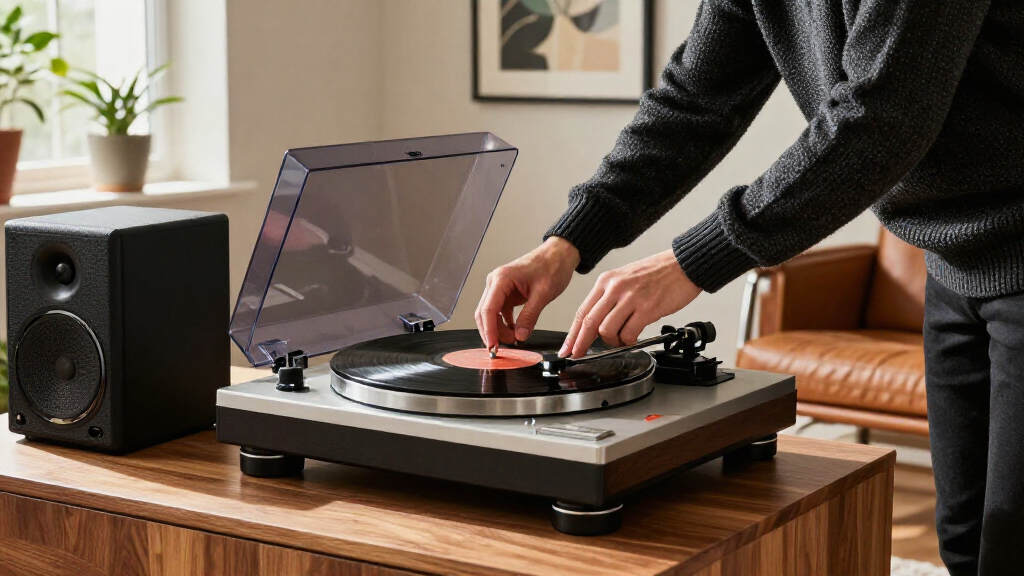
I ranked these turntables by how well their design serves a clear buyer need, weighing drive system, included cartridge, automation, connectivity, setup demands, construction, and room for future system changes. I also looked at the practical ownership picture: whether the deck asks the buyer to set up and operate it manually, whether it offers useful connections, and whether its capabilities suit home listening, archiving, or DJ-style use.
The order reflects fit and versatility, not a claim that one deck will sound best in every system. The Technics SL-100C leads as a focused direct-drive choice with broad appeal; the Denon DP-3000NE earns a premium position for buyers seeking a more ambitious deck. Automatic models rank well for convenience, while the Pioneer DJ PLX-1000 and connectivity-focused models serve narrower needs. I’ve kept the Fluance RT81 and AT-LP120XUSB in the comparison as more accessible routes into the category, while recognizing that they do not occupy the same premium tier as the Denon or Pro-Ject.
| high end turntable | Drive type | Cartridge |
|---|---|---|
| Fluance RT81 Elite Belt-Drive | Belt drive | Audio-Technica AT95E |
| Dual CS 529 Fully Automatic Tu | Belt drive | — |
| Technics SL-100C Premium Class | Coreless direct drive | Audio-Technica AT-VM95C, pre-installed |
| Audio-Technica AT-LP120XUSB-BK | Direct-drive DC servo motor | AT-VM95E dual-magnet with elliptical stylus |
| Pioneer DJ PLX-1000 Profession | Direct drive | — |
| Audio-Technica AT-LP8X Semi-Au | — | AT-VM95E with 0.3 x 0.7 mil elliptical stylus |
| Technics SL-40CBT Direct Drive | Coreless direct drive | Audio-Technica AT-VM95C |
| Dual CS 529 Fully Automatic Tu | — | — |
| Denon DP-3000NE Direct-Drive T | Direct drive | — |
| Pro-Ject XA B Acrylic Turntabl | Belt-driven | Pre-adjusted Pick it Pro Balanced |
Factors to Consider When Choosing Best High End Turntables
Before choosing, decide what “high-end” means for your listening room: fewer compromises in the turntable itself, easier daily operation, or a deck that fits a specific system and use. These broader choices can matter more than a single specification.
Choose a drive system for your habits, not a label
Belt-drive designs isolate the platter from the motor with a belt, while direct-drive models connect the motor more directly to the platter. Neither approach guarantees better playback on its own; implementation, setup, and the rest of the system matter. Direct drive is often a sensible match for frequent use and DJ-style handling, while belt-drive designs appeal to listeners who prefer a more traditional hi-fi format. Think about how often you play records and whether quick starts or hands-on cueing matter to you. Avoid treating drive type as a shortcut for sound quality: compare the complete design and the support it offers your listening routine.
Budget for the full playback chain
A turntable is only one part of an analog system. Check whether your amplifier or powered speakers have a phono input, and whether the deck includes a phono preamp when they do not. If you already own a preferred preamp, a built-in one may add little value; if you are assembling a simple system, it can reduce the number of extra components. Cartridge and stylus compatibility also affect future costs and upgrade choices. A common mistake is to spend the whole system budget on the deck, then pair it with unsuitable amplification or speakers. Set aside room for the supporting gear and basic setup tools before deciding how far up the turntable range to go.
Treat automation as a usability choice
Automatic and semi-automatic mechanisms can lower the effort involved in starting or ending a listening session. That convenience can be especially useful if you regularly listen while doing other things or want to reduce the chance of a stylus running in a locked groove. Manual decks give you direct control over cueing and may suit listeners who enjoy a more involved routine. Automation does not tell you whether a turntable is premium or basic, and it should not be confused with sound quality. Check exactly what the mechanism automates, since start, return, and stop functions vary. Choose based on how you will use the deck day to day, rather than assuming manual operation is inherently more serious.
Buy connectivity only when it solves a real problem
USB can help when you want to digitize records, but a transfer also depends on the recording software, computer setup, and care taken with levels and file formats. Bluetooth can make casual listening simpler with compatible speakers or headphones, though it adds a wireless link that traditional analog systems do not need. If your goal is a wired hi-fi setup, prioritize the output and phono-stage arrangement that fits your components. Extra ports are useful only when they match a real task; otherwise, they can distract from fit, construction, and cartridge choices. Decide whether you need archiving, wireless convenience, or neither before paying for features that may sit unused.
Plan for setup, placement, and maintenance
Even a capable deck can disappoint if it sits on an unstable surface or is not level. Leave enough space for the lid, record handling, and tonearm movement, and keep the turntable away from speakers that transmit strong vibration. Cartridge alignment, tracking force, and anti-skate settings affect record playback and stylus wear, so check how much setup the model requires and whether you are comfortable doing it. A basic level and appropriate alignment tools can be more useful than a cosmetic upgrade. Dust, stylus condition, and belt condition also deserve attention over time. Buyers who want to minimize hands-on setup should factor in service access and operating simplicity along with the initial design.
Pay more for capability you will keep using
A more expensive turntable makes sense when its build, drive design, upgrade options, or system fit will remain valuable as the rest of your setup improves. It is harder to justify a premium tier when the deck’s extra capability does not match your room, speakers, or listening habits. Consider whether you expect to change cartridges, add a separate phono stage, or use the same turntable for many years. Also ask whether a specialized feature, such as DJ-oriented operation, is central to your use or simply appealing on paper. A well-matched model with fewer extras can be a better long-term choice than a more elaborate deck used in a basic system. Spend for a clear benefit, not a vague promise of higher status.
Frequently Asked Questions
Is the Technics SL-100C a better choice than the Denon DP-3000NE for a home hi-fi system?
I’d choose the Technics SL-100C if I want a focused direct-drive turntable with fewer added conveniences and a broad role in a home system. The Denon DP-3000NE is the more premium-oriented option for buyers who want its higher-end feature set and are building the rest of the system to match. Neither choice is automatically better for every room or record collection. Compare the full system cost, including cartridge and phono stage needs, before deciding. If simplicity and upgrade flexibility lead your priorities, lean Technics; if the Denon’s specific features fit your setup, the extra complexity may be worthwhile.
Do I need an automatic turntable if I’m new to vinyl?
No, but automatic operation can make everyday listening less hands-on. The Dual CS 529 models are the clearest fit here if starting and stopping playback with minimal effort matters to you. A manual model can still be a good first turntable if you are comfortable cueing the tonearm and learning basic setup. The bigger beginner questions are whether you have a phono input or preamp, and whether you can set up the cartridge correctly. Choose automation for convenience, not because it removes every setup or maintenance task.
Which turntable in this roundup makes the most sense for digitizing records?
The Audio-Technica AT-LP120XUSB is the most direct fit because USB connectivity supports connecting the turntable to a computer for archiving. A USB port does not produce finished digital files by itself: you still need recording software, suitable settings, and time to check each transfer. If archiving is occasional, consider whether a separate capture setup would serve your wider system better. For mostly analog listening, do not let USB outweigh the qualities you will use every time you play a record. The Technics SL-40CBT’s Bluetooth serves a different purpose: wireless playback, not USB record capture.
Should I choose the Pioneer DJ PLX-1000 for home listening?
It can suit home listening if you also want a deck designed around DJ-style handling and operation. If your priority is relaxed hi-fi use, compare it with the Technics SL-100C or Pro-Ject XA B, which are more straightforward choices for listeners focused on a home playback setup. The Pioneer’s specialist role may be unnecessary if you do not need its DJ-oriented design. Also check what cartridge and phono equipment your intended setup requires. Buy it for the way you plan to use it, not just because direct drive sounds appealing.
Can I connect these turntables directly to powered speakers?
Only if the turntable has a suitable built-in phono preamp or the speakers include a phono input. Otherwise, you need a separate phono preamp between the turntable and speakers; a standard line input alone may not provide the correct signal equalization and level. Check the exact output configuration of the turntable and the input labels on your speakers before buying cables. Bluetooth-equipped speakers may pair with a compatible wireless turntable, but that is a different connection path from wired analog playback. Matching these connections first can prevent an otherwise capable deck from becoming an awkward system fit.
Conclusion
For the best overall fit, I recommend the Technics SL-100C for listeners who want a focused direct-drive deck without making automation or wireless features the priority. The Fluance RT81 is my best value pick for a simpler entry into vinyl, while the Denon DP-3000NE is the best premium choice for buyers building a more ambitious system. Beginners who value hands-off playback should look at either Dual CS 529; the walnut and black finishes offer the same basic convenience with a different look. For specific needs, choose the Audio-Technica AT-LP120XUSB for USB record archiving, the Technics SL-40CBT for Bluetooth convenience, or the Pioneer DJ PLX-1000 for DJ-style use. If you prefer a distinctive manual deck, the Pro-Ject XA B makes a more specialized alternative. Match the deck to your system and habits, and the choice becomes much clearer.