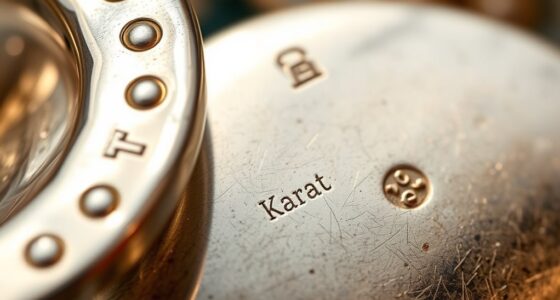
Hallmarks and assay offices are your assurance of genuine precious metals like gold and silver. They verify purity, origin, and quality through official stamps or marks, helping you feel confident in your jewelry or bullion. Assay offices use advanced testing methods to ensure metal content matches the hallmarks. Understanding these symbols and their significance safeguards you from fraud and guarantees transparency in your transactions. Stay with us to discover more about these essential standards.

Get your wardrobe favorites delivered free with Prime
- Fast, free delivery on millions of items
- Prime Video, Amazon Music and more included
- Member-only deals all year
Key Takeaways
- Hallmarks are official stamps indicating metal purity, origin, and assay office verification on precious metal items.
- Assay offices test and certify metals, ensuring authenticity and quality, and affix hallmarks as proof.
- Hallmarking standards specify minimum purity levels, such as 18K gold (75%) or sterling silver (92.5%).
- Modern testing uses techniques like X-ray fluorescence, with hallmarks providing reliable information about the item’s origin and purity.
- Knowledge of hallmarks and assay offices helps consumers verify authenticity, protect investments, and ensure high-quality precious metal purchases.

Hallmarks and assay offices play a crucial role in ensuring the authenticity and quality of precious metals like gold, silver, and platinum. When you buy or sell jewelry or bullion, understanding these marks helps you verify the metal’s purity and value. Central to this process are metal purity standards, which set the benchmark for how pure a metal must be to earn a specific hallmark. These standards vary by country but generally specify the minimum amount of pure metal in a piece, such as 18-karat gold containing 75% gold or sterling silver with 92.5% silver content. Assay offices test and certify that these standards are met, providing a trusted verification that safeguards both consumers and traders.
The tradition of hallmarking has deep historical roots, dating back centuries. Historically, hallmarking practices began as a way to protect consumers from fraud and to maintain trade standards. In medieval Europe, for example, local assay offices were established to evaluate and mark precious metals, creating a system of accountability. These early practices involved physically stamping the metal with symbols or marks indicating the origin, purity, and sometimes the maker. Over time, these hallmarking practices evolved into a standardized system, with specific symbols representing the assay office, the metal’s purity, and the date of assay. This history underscores the importance of hallmarking as a trust mechanism, ensuring buyers can rely on the marks they see on jewelry, coins, or bars. Today, modern assay offices continue this tradition, but with more sophisticated methods of testing and documentation. When your jewelry is assayed, technicians use precise techniques like X-ray fluorescence or fire assay to determine its true metal content. Once confirmed, the assay office affixes a hallmark—an official mark that indicates the metal’s purity and the verifying authority. This hallmark is often a combination of symbols, numbers, or letters, which together tell a story about the piece’s origin and quality. Knowing the history behind hallmarking practices and the standards they uphold increases your confidence when purchasing precious metal items, ensuring you’re investing in genuine, high-quality materials. This process relies on advanced testing methods such as X-ray fluorescence and fire assay, which are essential for accurate verification.
As an affiliate, we earn on qualifying purchases.
Frequently Asked Questions
How Often Do Assay Offices Update Their Hallmarking Standards?
Assay offices typically update their hallmarking standards annually or whenever changes occur in metal purity regulations or hallmark design requirements. You should stay informed through official notices to guarantee your jewelry or precious metal items meet current standards. Regular updates help maintain accuracy in marking metal purity and hallmark design, ensuring your pieces are correctly certified and compliant with legal standards. Keep checking with your local assay office for the latest updates.
Can Hallmarks Be Faked or Forged?
Yes, hallmarks can be faked or forged, especially in counterfeit jewelry. To protect yourself, always use hallmark verification methods, like checking for consistent markings and consulting trusted assay offices. Be cautious of suspiciously cheap or poorly made jewelry, and when in doubt, have your pieces inspected by a professional. These steps help guarantee your jewelry’s authenticity and prevent falling victim to forgery.
What Is the Oldest Assay Office Still in Operation Today?
You’ll find the London Assay Office is the oldest still in operation today, dating back to 1300. Its historical significance is immense, as it established standards for gold and silver, shaping trade and trust. Its cultural impact is also profound, influencing jewelry and craftsmanship worldwide. By maintaining these traditions, it continues to symbolize quality and authenticity, connecting the past with modern standards in precious metal verification.
How Do Assay Offices Ensure the Accuracy of Their Tests?
Did you know assay offices test millions of items annually? They guarantee accuracy by following strict testing protocols and regularly updating calibration procedures. These offices use advanced equipment and standardized methods to verify metal purity precisely. By maintaining rigorous quality controls and routine calibration, they detect even tiny impurities, guaranteeing trustworthy results. This meticulous process helps protect consumers and uphold the standards of precious metal authentication worldwide.
Are There International Differences in Hallmarking Requirements?
Yes, there are international differences in hallmarking requirements. You’ll find that regional variations exist, with some countries adhering to their own standards while others follow international standards to facilitate trade. These variations can include differences in the types of hallmarks, where they’re placed, and the purity marks required. When dealing across borders, you should always verify the specific hallmarking rules for each country to guarantee compliance and avoid issues.
As an affiliate, we earn on qualifying purchases.
Conclusion
Now you’ve seen how hallmarks and assay offices act like guardians, stamping your jewelry with a mark of trust. Picture those tiny symbols glinting under the light, telling stories of craftsmanship and authenticity. With this knowledge, you can confidently navigate the world of precious metals, knowing each mark is a badge of quality. Next time you wear or buy jewelry, imagine those tiny symbols shining like stars, reassuring you of their genuine beauty and value.
As an affiliate, we earn on qualifying purchases.
As an affiliate, we earn on qualifying purchases.
Fall Picks
fall essentials
As an affiliate, we earn on qualifying purchases.