
COSC certification guarantees your watch meets strict standards of precision through rigorous testing of its movement. The process involves evaluating performance in various positions, temperatures, and environmental conditions to guarantee long-term accuracy. The standards focus on maintaining precise timekeeping despite daily wear factors. If you want to understand how these meticulous tests and criteria work to deliver reliable performance, keep exploring for more detailed insights.
Key Takeaways
- COSC certification ensures watches meet strict accuracy standards, typically within -4 to +6 seconds per day.
- The testing process involves precise measurements over several days in various positions and temperatures.
- Environmental factors like magnetic fields, water, and temperature are carefully controlled during testing.
- Mechanical parts are scrutinized for wear, adjustments, and material quality to maintain long-term accuracy.
- A COSC chronometer demonstrates consistent performance, reliability, and high precision in diverse conditions.
The Origins and Purpose of COSC Certification

The COSC certification was created to set the standard for precision in watchmaking. Its historical significance lies in establishing a universal benchmark for chronometer accuracy, dating back to 1966. The certification process involves rigorous testing over several days, where watches are examined in various positions and temperatures to guarantee reliability. This process was designed to distinguish truly precise timepieces from ordinary watches, elevating the industry’s standards. When a watch passes these stringent tests, it earns the official chronometer designation, symbolizing exceptional accuracy. By maintaining strict criteria, COSC has become a symbol of quality and precision in horology, inspiring manufacturers worldwide to meet its demanding standards and ensuring consumers receive highly reliable timepieces. Additionally, the testing procedures incorporate precision measurement techniques that help uphold the integrity of the certification. These procedures also emphasize the importance of metrological standards, which are crucial for maintaining consistent accuracy across different timekeeping devices. Furthermore, the certification process incorporates regular testing to ensure ongoing compliance with the established standards, which helps in maintaining the long-term accuracy of certified watches.
The Testing Process for Chronometers

When testing chronometers, you need to understand the strict environmental conditions they face to make certain of accuracy. Precise measurement methods are used to evaluate their performance, adhering to specific certification criteria and standards. These factors together guarantee that only the most reliable timepieces earn COSC certification. Vetted processes ensure that only high-quality chronometers meet the rigorous requirements. Additionally, the testing procedures account for temperature stability to ensure consistent performance under various conditions. Incorporating insights from blockchain data management enhances the reliability of the testing environment by ensuring data integrity and accuracy. Maintaining a controlled environment with environmental regulation is crucial for consistent testing results. Furthermore, understanding the 16PF traits can aid in analyzing the consistency and reliability of the personnel involved in the testing process.
Testing Environment Conditions
Ensuring accurate testing conditions is essential for evaluating a chronometer’s precision reliably. You need to control environmental factors like magnetic interference and water resistance. External magnetic fields can disrupt the movement, so testing occurs in magnetically shielded rooms. Water resistance is also critical; tests are performed in sealed chambers that simulate real-world conditions. To visualize, consider this table:
| Condition | Impact on Testing |
|---|---|
| Magnetic interference | Can cause timing inaccuracies |
| Water resistance | Ensures durability and stability |
| Temperature control | Maintains consistent operation |
| Humidity levels | Prevents corrosion and malfunctions |
Precision Measurement Methods
How do experts accurately measure a chronometer’s precision? They use a series of rigorous tests in controlled conditions. First, the watch face is carefully inspected for clarity and consistency, ensuring no glare or distortion affects readings. The watch is placed in a vibration-free environment, often with temperature and humidity monitored, to prevent external influences. Measurement involves tracking the movement’s accuracy over several days, recording deviations in seconds per day. Experts also examine strap materials to ensure they don’t interfere with performance, as a loose or stiff strap can affect stability. Multiple positions and orientations are tested to confirm consistent timekeeping. This meticulous process guarantees the chronometer meets strict precision standards before it receives official certification.
Certification Criteria and Standards
Certification criteria and standards define the rigorous testing process a chronometer must pass to earn official recognition. This process has evolved over time, reflecting advancements in horology and a deeper understanding of precision. Historically, the certification process began with simple timekeeping checks but has become a thorough evaluation encompassing various conditions. Modern standards, set by organizations like COSC, require the movement to maintain accuracy within strict limits over several days, in different positions and temperatures. These criteria ensure only the most reliable watches earn the chronometer designation. The certification process involves precise testing methods, verification, and documentation, establishing a benchmark for quality and precision. This evolution in standards guarantees that certified chronometers deliver exceptional performance, meeting the highest expectations for accuracy in timekeeping.
Key Criteria for Certification Standards
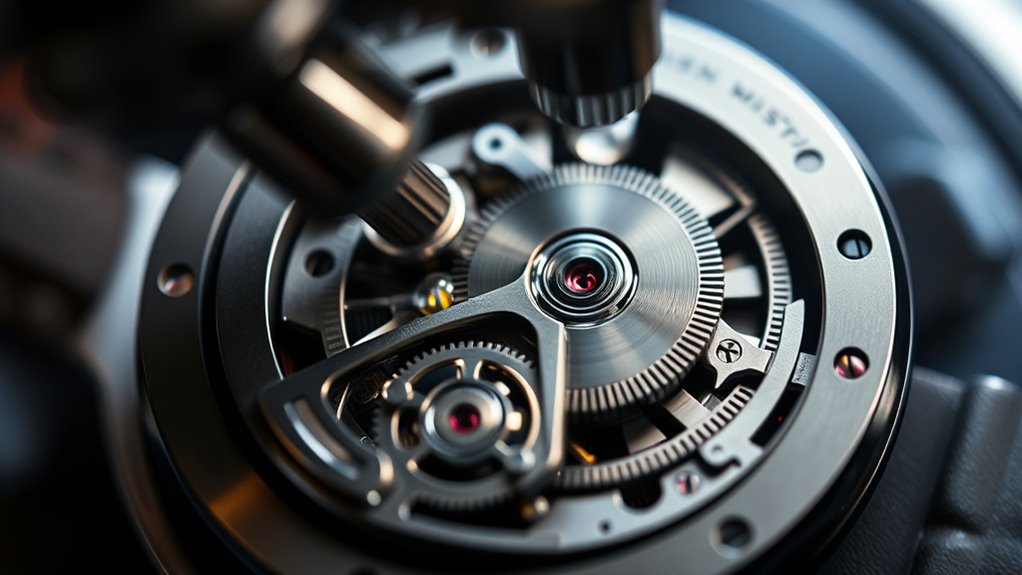
To achieve COSC certification, certain key criteria must be met to demonstrate the accuracy and reliability of a chronometer. The standards focus on precision, requiring the watch to maintain a daily variation of only -4/+6 seconds. You need to guarantee the movement’s consistency across different positions and temperatures, which reflects the watch’s durability and performance. For luxury branding, meeting these strict standards boosts credibility and elevates the watch’s prestige. Marketing strategies often highlight the rigorous testing process to appeal to discerning customers who value precision. Certification not only proves technical excellence but also reinforces the brand’s commitment to quality. Additionally, understanding the concept of Free Floating balance wheels helps explain how some high-precision watches achieve their accuracy by allowing the balance to move independently, reducing external influences. The vetted standards ensure that only the most reliable and accurate timepieces are awarded the certification, thereby maintaining high industry benchmarks. Incorporating temperature compensation techniques further enhances the watch’s ability to maintain accuracy in varying environmental conditions. Implementing anti-shock mechanisms also plays a crucial role in safeguarding the movement against external shocks, ensuring sustained precision. By adhering to these key criteria, your timepiece stands out as a trustworthy, high-performance instrument in the competitive luxury market.
The Role of Mechanical Movements in Accuracy
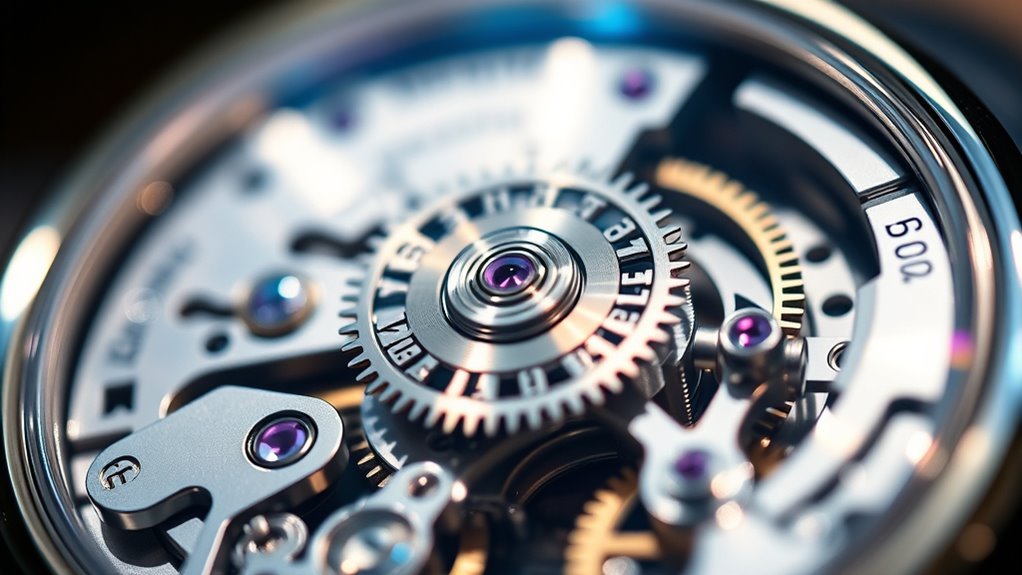
Mechanical movements play a pivotal role in determining a watch’s accuracy, as their design and craftsmanship directly influence timekeeping stability. The intricate arrangement of mechanical components, especially the gear train, regulates energy transfer from the mainspring to the escapement. Precision in each gear reduces errors, ensuring reliable performance. The gear train acts as the watch’s backbone, translating rotational energy into consistent oscillations. Variations or imperfections here can cause deviations in timekeeping. To illustrate this, consider the table below:
| Mechanical Component | Function | Impact on Accuracy |
|---|---|---|
| Gear train | Transfers energy | Stabilizes movement |
| Balance wheel | Oscillates regularly | Maintains timing |
| Escapement | Regulates energy release | Ensures precision |
These parts work together to keep your watch ticking precisely. Additionally, manufacturing tolerances and material quality significantly affect the long-term accuracy and durability of the movement. Proper calibration procedures are essential for maintaining optimal performance over time.
How Daily Position Testing Affects Performance
Performing daily position testing helps you spot small changes before they affect accuracy, especially as parts wear over time. Regular adjustments keep your watch consistent, even when conditions vary. By maintaining a strict testing routine, you can guarantee reliable performance day after day. Incorporating timing accuracy checks into your routine ensures adherence to chronometer standards and maintains overall reliability. Furthermore, understanding mechanical wear allows for better scheduling of maintenance to preserve precision. Recognizing component degradation can help prevent unexpected inaccuracies and extend the lifespan of your timepiece. Additionally, consistent monitoring of movement stability can help identify issues early, ensuring your chronometer remains precise.
Daily Adjustment Practices
Daily position testing plays a vital role in maintaining COSC accuracy by enabling you to identify and correct deviations promptly. Regular adjustments keep your watch aligned with strict standards, reflecting the luxury branding associated with precision timepieces. Over time, this practice has evolved from manual fine-tuning to sophisticated, automated procedures, showcasing the historical evolution of chronometer calibration. To understand the importance, consider this simple comparison:
| Adjustment Method | Precision Level | Ease of Use |
|---|---|---|
| Manual | High | Requires skill |
| Semi-Automatic | Very high | Moderate effort |
| Fully Automated | Excellent | User-friendly |
This table highlights how advancements enhance performance and consistency, underlining the significance of daily adjustments in achieving COSC standards.
Impact of Wear and Tear
Regular adjustments help maintain your watch’s accuracy, but over time, wear and tear from daily use can undermine these efforts. Wear induced inaccuracies occur as components experience friction, causing slight deviations in timekeeping. Mechanical wear effects, such as worn gears and pivots, reduce efficiency and can lead to inconsistent performance. Daily position testing reveals these issues by exposing subtle deviations caused by accumulated wear. As parts degrade, your watch’s ability to maintain precise timing diminishes, especially in different orientations. Continuous use accelerates mechanical wear, making regular servicing essential to restore accuracy. Ignoring wear and tear can result in persistent inaccuracies, despite frequent adjustments. Ultimately, understanding how daily wear impacts your watch helps you better anticipate when maintenance is needed to keep your chronometer performing at its best.
Consistency in Testing Conditions
Consistent testing conditions are essential for accurately evaluating your watch’s performance. Variations in daily testing, like changing time zones, can affect accuracy and reliability. Regularly adjusting for time zone differences guarantees your watch maintains precision. Additionally, conducting water resistance testing under similar conditions guarantees consistent results, preventing false negatives due to environmental factors. To help visualize, here’s a simple overview:
| Testing Aspect | Key Considerations | Impact on Accuracy |
|---|---|---|
| Time Zone Adjustments | Consistent calibration during travel | Ensures reliable timekeeping |
| Daily Position Testing | Same positions during testing | Reduces variability in results |
| Water Resistance Tests | Same conditions and depth | Maintains integrity and performance |
| Temperature Control | Testing in similar environments | Prevents temperature-related errors |
| Power Reserve Checks | Same winding and usage patterns | Ensures consistent performance |
Temperature Variations and Their Impact on Precision
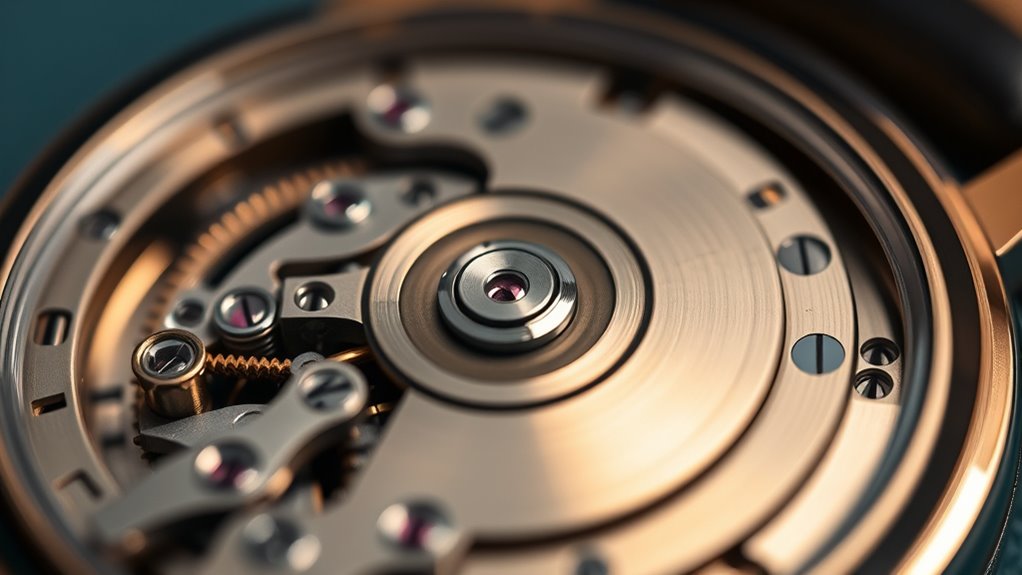
Temperature variations can markedly affect the accuracy of COSC-certified watches by causing the internal components to expand or contract. This process, known as thermal expansion, influences the movement’s precision. To counteract this, watchmakers perform careful temperature calibration, ensuring the watch remains accurate across temperature changes. Consider these key points:
- Small temperature shifts can cause measurable timing errors due to material expansion.
- Precise temperature calibration helps maintain accuracy despite environmental fluctuations.
- High-quality materials with low thermal expansion coefficients reduce the impact of temperature changes.
The Significance of Power Reserve and Stability
A reliable power reserve is vital for maintaining COSC-certified watch accuracy, especially during periods of inactivity. When your watch has sufficient power reserve, it guarantees consistent energy delivery, which supports overall stability in timekeeping. Without adequate reserve, the watch’s movement can become inconsistent, leading to deviations from precise time. A stable power reserve helps the watch resist external shocks and temperature fluctuations, maintaining accuracy over time. High-quality movements are designed to hold a steady power flow, reducing variations caused by worn components or low energy levels. This stability is essential for meeting COSC standards, which demand tight control over daily deviations. Ultimately, a good power reserve safeguards your watch’s precision, ensuring reliable performance even between windings or during extended periods of non-use.
Comparing COSC Standards to Other Accuracy Benchmarks
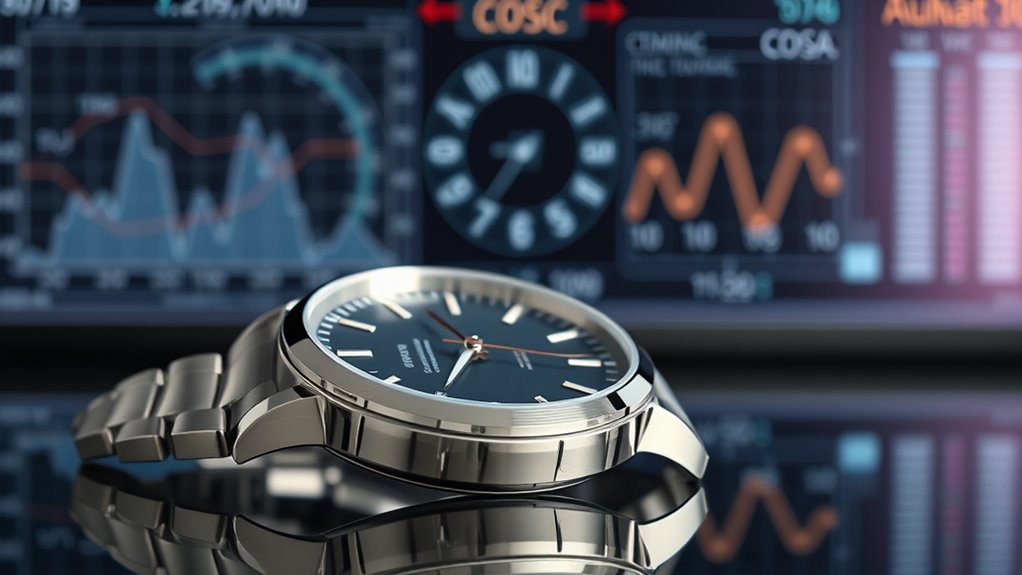
While COSC certification is widely regarded as a benchmark for accuracy, other standards often set different expectations for watch performance. You should understand that:
- Some brands prioritize luxury branding, emphasizing design over strict chronometer precision.
- The market reputation of a watch can depend more on craftsmanship, exclusivity, or brand heritage than on COSC certification alone.
- Alternative standards, like ISO 3159 or Rolex’s Superlative Chronometer, may allow slightly looser tolerances but still guarantee high-quality performance.
Comparing these benchmarks helps you see that accuracy isn’t the sole factor influencing a watch’s prestige. Instead, a combination of precision, craftsmanship, and branding affects how a watch is perceived in the luxury market.
Maintaining Chronometer Precision Over Time
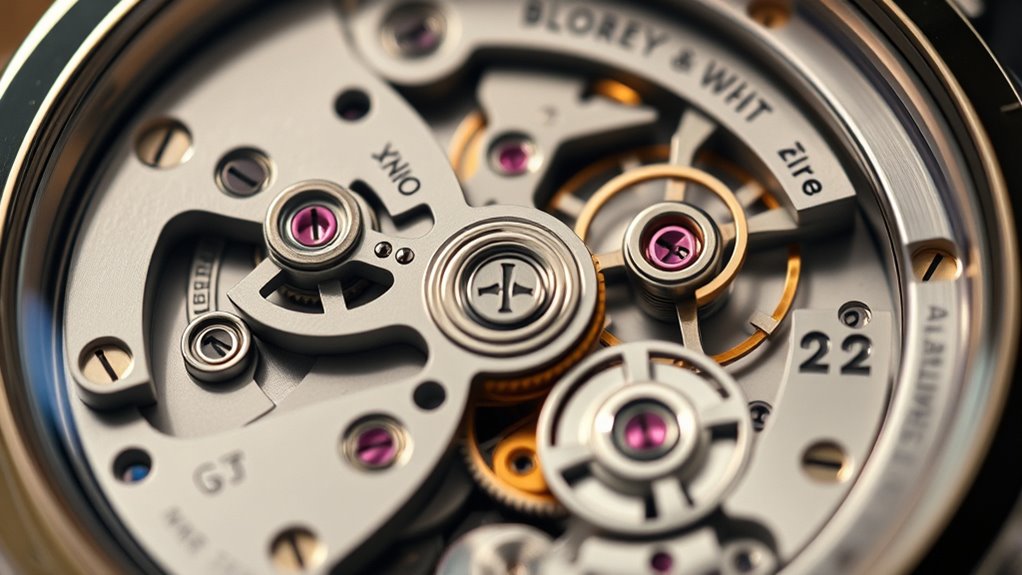
To keep your chronometer precise over time, you need to regularly calibrate it to account for any subtle shifts. Environmental factors like temperature and humidity can also affect its accuracy, so controlling these conditions is vital. By staying vigilant with calibration and environmental management, you ensure your timekeeping remains reliably accurate.
Regular Calibration Practices
Regular calibration is essential for maintaining the accuracy of your chronometer over time. To guarantee consistent precision, check your watch face regularly for dust or scratches that can affect readability. Consider the strap material; a worn or damaged strap can cause the watch to shift, impacting calibration. To keep your chronometer performing at its best, follow these practices:
- Schedule weekly calibration checks against a reliable time source.
- Use proper tools to adjust the movement without damaging delicate parts.
- Keep the watch away from magnetic fields that can disrupt accuracy.
Environmental Impact Factors
Environmental factors can considerably affect your chronometer’s accuracy over time. Temperature fluctuations, humidity, magnetic fields, and shocks can all influence its performance. Changes in temperature can cause materials to expand or contract, disrupting the delicate balance of the movement. Humidity may lead to corrosion or deterioration of internal components, while magnetic fields can magnetize parts, affecting timing precision. Shocks or vibrations can shift or damage tiny parts, degrading accuracy. Material stability is vital; high-quality materials resist environmental stress and help maintain consistent performance. To guarantee your chronometer remains precise, it’s essential to minimize exposure to adverse environmental factors. Proper storage, regular maintenance, and understanding these influences help preserve the material stability of your timepiece, guaranteeing it continues to meet accuracy standards over time.
Benefits of Owning a COSC-Certified Watch

Owning a COSC-certified watch offers you assurance of exceptional accuracy and reliability. This certification enhances the watch’s luxury appeal, signaling quality and craftsmanship. Additionally, it can boost the investment value of your timepiece, making it more desirable over time. Consider these benefits:
- Enhanced prestige: Demonstrates your appreciation for precision and high standards.
- Long-term reliability: Ensures your watch maintains accuracy, reducing maintenance costs.
- Resale potential: Increases the watch’s desirability and market value, making it a wise investment.
Frequently Asked Questions
Can Non-Cosc Watches Be as Accurate as Certified Chronometers?
Non-COSC watches can be just as accurate as certified chronometers, but it’s less common. Precision standards vary widely among brands, and many high-quality watches meet stringent accuracy criteria without going through the official certification process. Certification involves rigorous testing, ensuring the watch adheres to specific precision standards. So, while non-COSC watches might not have certification, they can still deliver exceptional accuracy depending on their craftsmanship and movement quality.
How Often Should a Cosc-Certified Watch Be Recalibrated?
You should recalibrate your COSC-certified watch every 6 to 12 months to maintain its precision. Studies show that even certified chronometers can drift by a few seconds daily without proper watch maintenance. Regular calibration frequency helps ensure accuracy, so consider having it tested and adjusted annually. This proactive approach keeps your watch running reliably, preserving its chronometer status and accuracy over time.
Does COSC Certification Affect the Watch’s Resale Value?
Yes, COSC certification can positively affect your watch’s resale valuation, especially among collectors who value precision and quality. Having a chronometer-certified watch demonstrates high standards, increasing its appeal and perceived worth. This certification adds to the watch’s authenticity and prestige, making it more desirable on the secondary market. So, if you’re considering resale, a COSC-certified watch often commands a higher price and stronger collector appeal.
Are Quartz Watches Eligible for COSC Certification?
Is a quartz watch a knight in shining armor for chronometer certification? Sadly, no. Quartz watches aren’t eligible for COSC certification because they rely on a battery-powered quartz crystal rather than mechanical movements. While quartz watches can achieve excellent chronometer accuracy, only mechanical watches undergo the rigorous testing required for COSC certification. So, if you seek that official chronometer badge, mechanical is the way to go.
What Are Common Misconceptions About COSC Chronometers?
Many people think COSC chronometers guarantee perfect mechanical precision, but that’s not true. The certification standards only require watches to meet specific accuracy ranges, not perfection. You might assume all certified watches are flawless, but minor deviations can occur. Remember, COSC certification indicates the watch meets rigorous standards, yet it doesn’t mean it won’t need adjustments over time. Keep your expectations realistic and understand what the certification actually signifies.
Conclusion
By choosing a COSC-certified watch, you’re getting a timepiece tested to keep within -4/+6 seconds daily, ensuring exceptional accuracy. This certification not only guarantees precision but also reflects quality craftsmanship. Did you know that only about 3% of Swiss watches earn COSC certification? So, when you wear one, you’re confidently wearing a piece that’s been rigorously tested to meet the highest standards of chronometer accuracy.